About Tylosurus crocodilus (Péron & Lesueur, 1821)
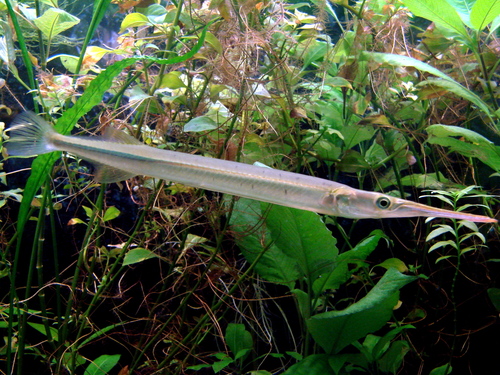
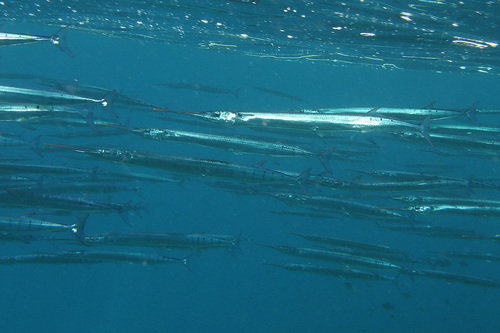
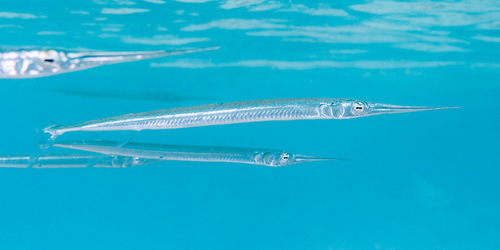
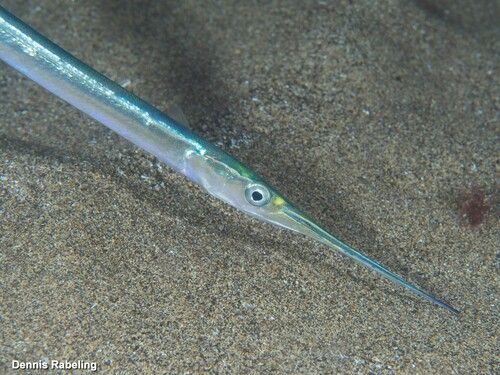
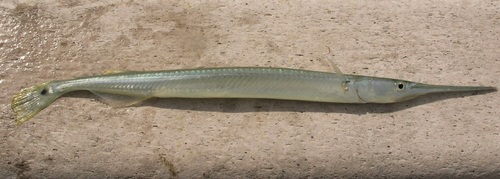
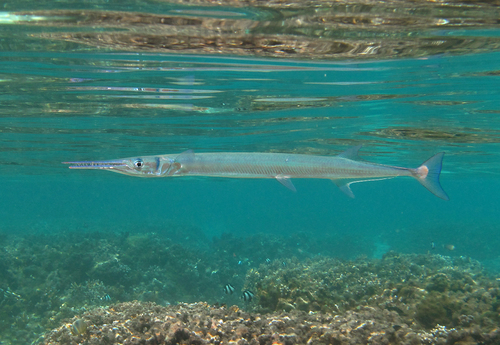
Tylosurus crocodilus, commonly known as the houndfish, can be distinguished from other species in the genus Tylosurus by a key trait: when houndfish are juveniles, their teeth point anteriorly, while the teeth of all other Tylosurus species remain straight across all life stages. Compared to other needlefishes, houndfish have a stouter, more cylindrical body and a shorter head. Juvenile houndfish also have an elevated black lobe on the posterior part of their dorsal fins. Houndfish have no fin spines; their dorsal fin holds 21–25 soft rays, their anal fin holds 19–22 soft rays, and they have between 80 and 86 vertebrae. Their coloration is dark blue on the back, silver-white along the sides, and plain white on the ventral side. They have a distinct keel on the caudal peduncle, and their caudal fin is deeply forked. The longest recorded houndfish reached 150 centimetres (4.9 ft), and the heaviest recorded individual weighed 6.35 kilograms (14.0 lb). Houndfish are distributed across the Indian and Pacific Oceans, with a range that extends from the Red Sea and the coast of South Africa east to French Polynesia, north to Japan, and south to New South Wales, Australia. In the eastern Pacific, the houndfish is replaced by its close relative the Mexican needlefish. In the Atlantic Ocean, houndfish occur from New Jersey to Brazil in the west Atlantic, and in the east Atlantic they are found from Fernando Poo, Cameroon, and Liberia to Ascension Island, with additional populations near Guinea, Senegal and Cape Verde. This species has also been recorded in the eastern Mediterranean Sea, after entering from the Red Sea via the Suez Canal as part of Lessepsian migration. Houndfish are pelagic, and occur as individuals or small groups over lagoons and seaward reefs. They feed mainly on smaller fishes. Houndfish lay eggs, and each egg has surface tendrils that allow it to attach to floating objects in the water.