About Tylopilus rhoadsiae (Murrill) Murrill
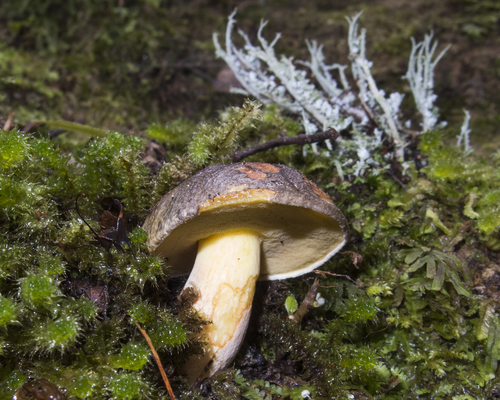
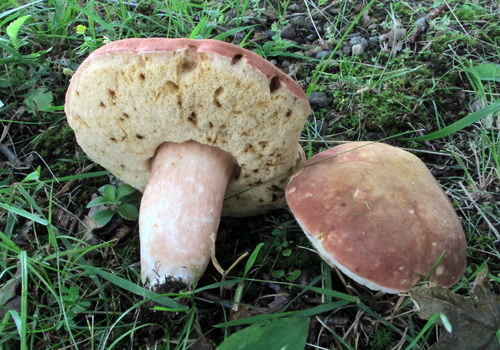
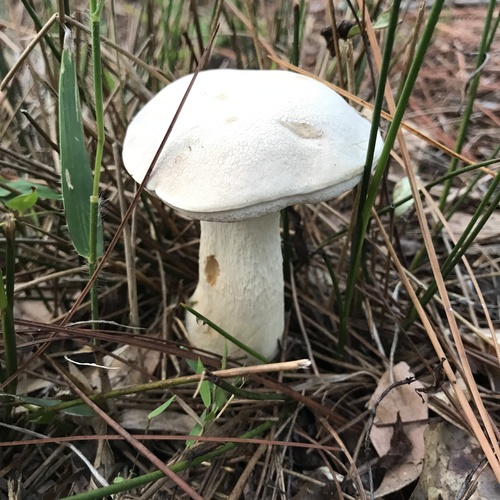
The fruit bodies of Tylopilus rhoadsiae have convex to flattened caps 6–9 cm (2.4–3.5 in) in diameter. The cap surface is dry, ranges from smooth to slightly hairy, and is sometimes shiny. Caps are whitish, sometimes mixed with buff, greyish buff, or pinkish tones. The mushroom's flesh is white, has no distinct odor, and has a bitter taste that makes the species inedible. The flesh does not change color when cut or injured. On the underside of the cap, the pore surface is initially white, and turns pale pink as spores mature. The pores are irregularly shaped, with approximately 1 to 2 pores per millimetre, while the pore tubes are 0.9–1.6 cm (0.4–0.6 in) long. The stipe measures 5–10 cm (2.0–3.9 in) long by 1.6–2.8 cm (0.6–1.1 in) thick, and is roughly equal in width along its length, though it may have a pinched base. The stipe surface is dry, whitish or a color matching the cap, and has distinct mesh-like reticulations on its upper half. The spore print of Tylopilus rhoadsiae is pinkish to brown-violaceus. Individual spores are smooth, oblong to elliptical, and translucent (hyaline) to pale yellow, measuring 11–13.5 by 3.5–4.5 μm. A drop of dilute potassium hydroxide or ammonium hydroxide solution turns the cap cuticle yellow. Tylopilus rhoadsiae fruit bodies grow scattered or in groups on the ground under pine and oak trees, and prefer sandy soil as a substrate. Fruiting occurs from July to October. This bolete is found in eastern United States, with a range that extends from New Hampshire south to Florida, and west to Texas. It is common along the Gulf Coast and on the coastal plains of North Carolina.