About Tylopilus plumbeoviolaceus (Snell & E.A.Dick) Snell & E.A.Dick
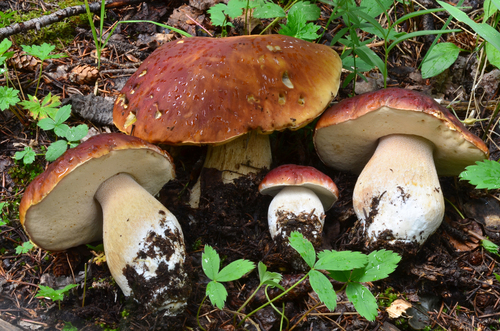
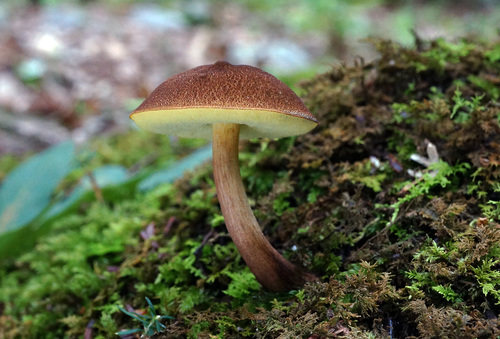
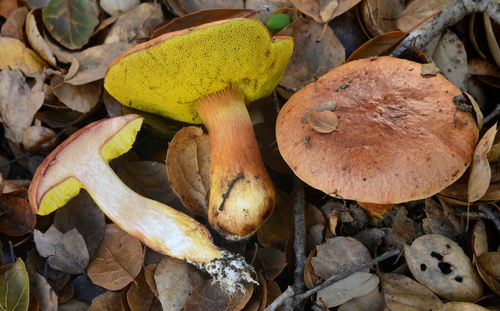
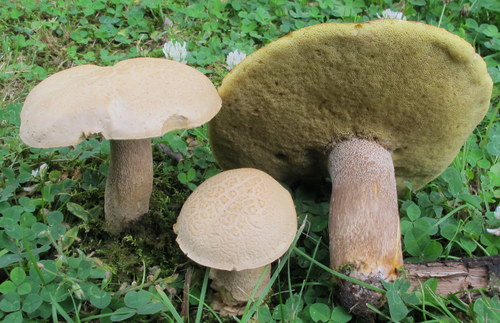
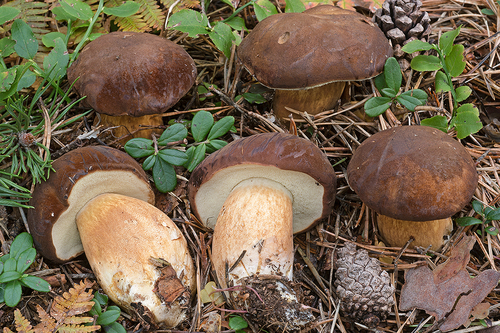
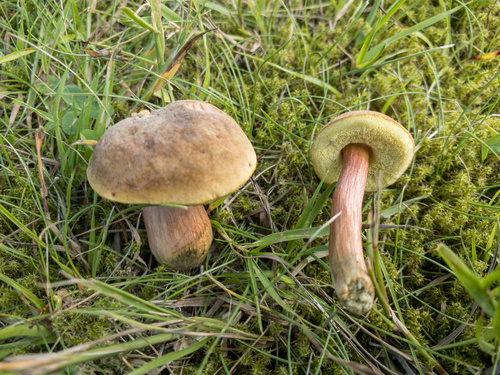
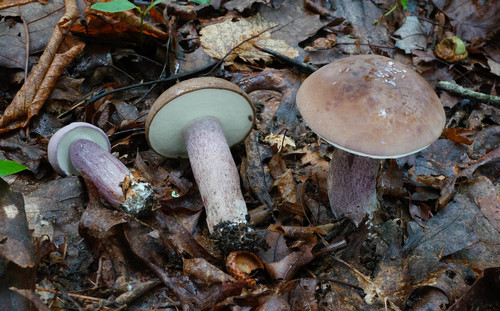
The fruit body cap of Tylopilus plumbeoviolaceus measures 7 to 15 cm (2.8 to 5.9 in) in diameter. It starts out convex, then develops a central depression, and has a broadly arched, rounded margin. Young specimens are hard and firm, with a finely velvet-textured cap surface that wears smooth over time. Young fruit bodies are violet in color; this color dulls with age, shifting to a dull violet-purplish-gray, and finally becoming chocolate-brown when fully mature. The cap flesh is solid and white, and does not change color when cut or bruised. This mushroom has a bitter taste and no distinctive odor; mycologist David Arora describes it as "beautiful, but bitter-tasting". The tubes on the underside of the cap are 0.4 to 1.8 cm (0.2 to 0.7 in) deep, spaced 2 to 3 per millimeter, and attach to the stem in an adnate arrangement, meaning they are depressed at the stem. The pore surface starts white, stays white for some time, and eventually turns rosy when the mushroom matures. The stem is 8 to 13 cm (3.1 to 5.1 in) long, 2.5 to 4 cm (1.0 to 1.6 in) thick, and is enlarged at the base, sometimes growing into a bulb shape. The stem surface is slightly reticulate near the top and smooth along the lower section. It is colored buff to light brown, often marked with darker brown bruises or stains, and has whitish mycelium at its base. The stem flesh is white and does not change color when cut or bruised. Spore prints of Tylopilus plumbeoviolaceus are light pink to flesh-colored. Viewed under a light microscope, spores are elliptical with smooth walls, and measure 9.1–12.3 by 3.4–4.5 μm. The spore-producing basidia are club-shaped, and measure approximately 26 by 6.5 μm. The cap cuticle (pileipellis) is formed from a tangle of narrow, smooth-walled, brownish hyphae. When stained with potassium hydroxide, the hyphal contents tend to form beads; when stained with Melzer's reagent, the pigment forms globules. Cystidia are common in the hymenial tissue; they are lageniform, meaning swollen at the base and narrow at the apex, and measure 30–40 μm long by 7–9 μm thick. Clamp connections are not present in the hyphae. Tylopilus plumbeoviolaceus is a mycorrhizal species; most of its structure lives underground, forming a mutualistic relationship with the roots of various tree species. Fruit bodies grow singly, scattered, or in clusters from mid-summer to autumn in deciduous forests, most often under beech or oak trees. The species sometimes grows in mixed hardwood-conifer forests under hemlock, and is noted to prefer sandy soil. In North America, it occurs in the west from June to September, and ranges from Canada to Mexico east of the Rocky Mountains. Specimens have also been collected in North Korea. Fruit bodies of Tylopilus plumbeoviolaceus can act as a food source for fungus-feeding Drosophila flies.