About Tussilago farfara L.
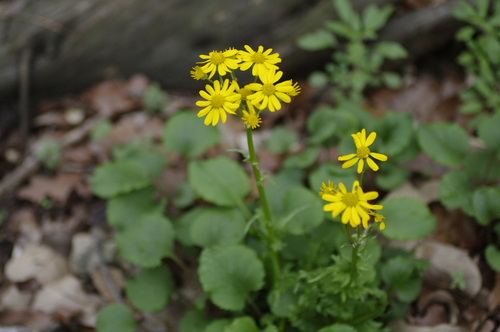
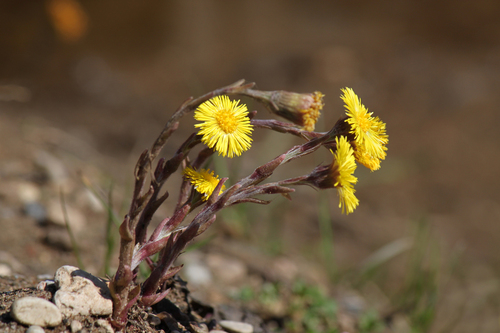
Tussilago farfara L., commonly known as coltsfoot, is a perennial herbaceous plant that spreads via both seeds and rhizomes. It often grows in colonies that can include dozens of individual plants. The plant’s flowers, which bear a superficial resemblance to dandelions, produce scale-leaves on their long stems and emerge in early spring. The large leaves of coltsfoot do not appear until after the flowers have finished producing seed, and these leaves then wither and die by early summer. Flower heads are made up of yellow florets, surrounded by an outer row of bracts. Mature plants typically reach a height between 10 and 30 cm (3.9 to 11.8 in), and leaf margins have distinct angular teeth.
Coltsfoot is native and widespread across Europe, Asia, and North Africa, ranging from Svalbard in the north to Morocco in the south, and east to China and the Russian Far East. It has also been introduced to North and South America, where it is now a common plant; it was most likely brought to the continents by settlers, either for use as a medicinal plant or to provide early-season blooms for honeybees. It grows most often in waste ground, disturbed sites, and alongside roadsides and paths. In some regions, it is classified as an invasive species.
Tussilago farfara contains tumorigenic pyrrolizidine alkaloids. Two specific pyrrolizidine alkaloids found in the plant, senecionine and senkirkine, showed the highest mutagenic activity among all tested pyrrolizidine alkaloids in a comparative genotoxicity study conducted using Drosophila melanogaster. Two reported cases of liver damage and death linked to drinking coltsfoot tea were later confirmed to stem from plant misidentification rather than consumption of Tussilago farfara. In the first case, an infant developed severe liver problems from a tea that was later confirmed to contain Adenostyles alliariae (alpendost), not coltsfoot. In the second case, an infant developed liver disease and died after their mother drank tea during pregnancy that was originally thought to contain coltsfoot, but which was later shown to be Petasites hybridus (butterbur) or a closely related species. One documented case notes that a 27-year-old male may have developed non-lethal deep vein thrombosis and pulmonary embolism after ingesting a multicomponent herbal supplement that included coltsfoot. In response to confirmed toxicity risks from its pyrrolizidine alkaloids, the German government banned the sale of coltsfoot. Clonal coltsfoot plants that do not contain pyrrolizidine alkaloids were later developed in Austria and Germany, leading to the creation of the registered cultivar Tussilago farfara 'Wien', which has no detectable levels of these toxic alkaloids.
Coltsfoot has a history of use in herbal medicine, and it has been used as an ingredient in food products, including confectionery such as Coltsfoot Rock. In traditional Austrian medicine, Tussilago farfara leaves are used either internally (as tea or syrup) or externally (direct application) to treat a range of conditions including respiratory tract disorders, skin disorders, locomotor system disorders, viral infections, flu, colds, fever, rheumatism, and gout. Extract from fresh coltsfoot leaves is also used to make cough drops and hard candy. The plant serves as a food source for the larvae of some Lepidoptera species, including the Gothic moth and the small angle shades moth. It is also commonly visited by honeybees, which collect its pollen and nectar.