About Turtur tympanistria (Temminck, 1809)
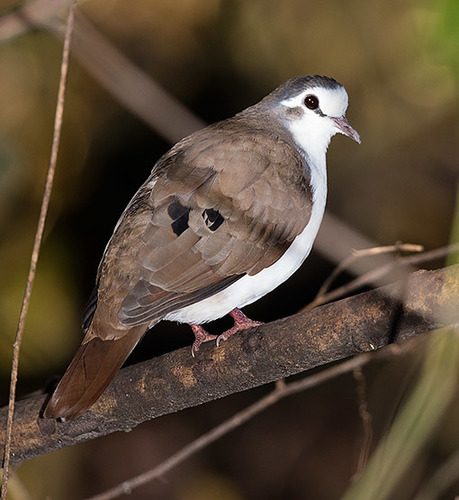
The tambourine dove, with the scientific name Turtur tympanistria, is a widespread resident breeding pigeon native to Africa south of the Sahara Desert. Its range stretches east from Senegal to Ethiopia and Kenya, then south through eastern Africa to southeastern South Africa. It is not found in the drier regions of southwestern Africa, and a separate population lives on the Comoros Islands. This species strongly favors thick wooded habitats, which also include dense gardens, and castor oil, cocoa, and rubber plantations. It is a shy species, and is most often seen when it is flushed out while feeding on the forest floor. The tambourine dove builds a frail stick nest low down in a thicket or vine tangle, and lays a clutch of two cream-coloured eggs. Both sexes take part in incubation, though the female handles most of this work. The eggs hatch after 13 days, and chicks take another 13 to 14 days to reach fledging. Chicks are fed with regurgitated food. This is a small, plump pigeon that typically reaches 22 centimeters in total length. Adult males have a white face with a black spot behind the eye, white underparts, and a grey crown. The back, hind neck, wings, and tail are pale grey brown, and large dark purple patches appear on the folded wings. The under tail is brown, the eye ring and feet are purple-red, and the bill is purple. Adult females are duller in plumage, and only have white coloration on the belly; their face and breast are pale grey-brown. Their crown is grey-brown, and lacks the blue-grey tone seen on males. Juvenile tambourine doves resemble adult females, but have chestnut fringes on the feathers of their back, breast, and flanks. Even with these varied plumage types, this species is paler on its underparts than other small African doves. The flight of the tambourine dove is fast and agile, and it tends to fly quite low when flushed. When in flight, it displays chestnut primary flight feathers and chestnut underwings. Its call is a persistently repeated sequence of du-du-du-du-du. Tambourine doves are usually solitary, but may sometimes be found in family groups or alongside lemon doves. They are quite terrestrial, and typically forage on the ground for seeds and small fruits. They have a specific preference for castor oil plant seeds, and will occasionally eat small insects and molluscs.