About Turtur chalcospilos (Wagler, 1827)
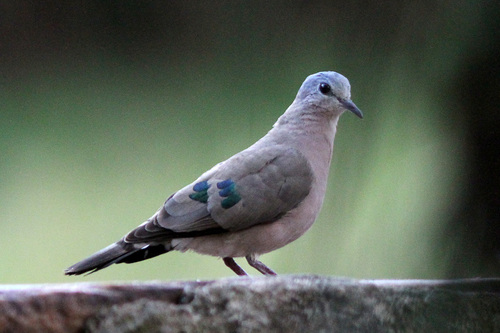
The emerald-spotted wood dove, with the scientific name Turtur chalcospilos (Wagler, 1827), is a small, plump pigeon that typically reaches 20 cm in length. Its back, hindneck, wings, and tail are pale grey-brown, and green metallic patches are present on the folded wings. Blackish bands appear on the lower back and tail. The forehead, crown, and nape are bluish-grey, which fades to pinkish-grey on the throat. Its underparts are mauve-pink, turning whiter on the belly. The bill of this dove is blackish with a red base. The sexes are similar in appearance, but females may be slightly duller than males. Immature individuals have duller green spots and buff fringes along their feathers. When in flight, this species can be distinguished from the black-billed wood dove by the black-billed wood dove's bright chestnut underwings. Its call has three distinct parts: it begins with two soft long coos, followed by a 10-second series of slow descending coos, and ends with 4 seconds of rapid coos that decrease in volume. This species shows some geographical variation in plumage, but these differences are clinal, so the emerald-spotted wood dove is currently considered to be monotypic.