About Turtur abyssinicus (Sharpe, 1902)
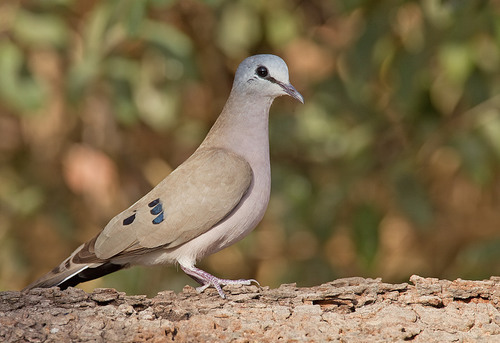
The black-billed wood dove, also called the black-billed dove, has the scientific name Turtur abyssinicus, and is a species of pigeon. It is a widespread resident breeding bird that lives across a belt of Africa just south of the Sahara Desert. This species is abundant in near-desert, scrub, and savannah habitats. It builds a stick nest in a tree, most often an acacia, and lays two cream-colored eggs. Its flight is quick, with the regular wing beats and occasional sharp wing flicks that are characteristic of most pigeons, and it tends to fly quite low to the ground. The black-billed wood dove is a small, plump pigeon that typically reaches 20 cm in total length. Its back, hindneck, wings, and tail are pale grey-brown, and dark metallic patches appear on its folded wings. There are two blackish bands across its back. The forehead, crown, and nape are bluish-grey, and this color fades to whitish on the face. Its underparts are pinkish, turning whiter toward the belly. As its common name suggests, this dove's bill is black. When in flight, the black-billed wood dove displays chestnut coloring on its underwing. Its call is a persistent, fluted coo-coo-cu-coo. Adult males and females are similar in appearance. Immature birds are duller in color than adults, have scaly patterning on their underparts, and lack the dark spots on the wings. Black-billed wood doves feed on grass and other small seeds. They are quite terrestrial, and usually forage for food on the ground. They are not very gregarious, but will form large flocks when gathering at waterholes. While this species is classified as Least Concern on the IUCN Red List, its global population has decreased significantly since 2004.