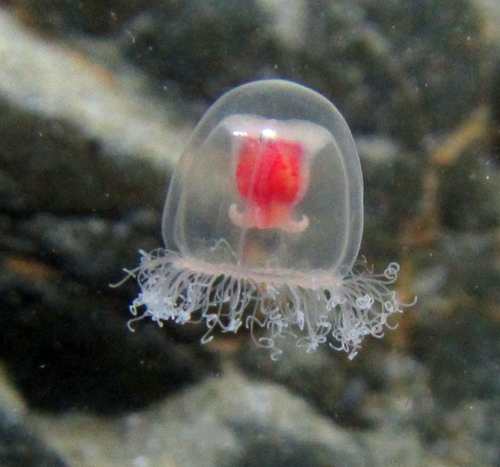
About Turritopsis rubra (Farquhar, 1895)
Turritopsis rubra, commonly called the crimson jellyfish, is a hydrozoan species in the small Turritopsis genus. It falls on the slightly larger end of the genus' size range, with adults measuring between 3 and 7 millimeters depending on their current life cycle stage, which is roughly the size of a pinky fingernail. Like most jellyfish, its body is very simple with few organs. Under its transparent umbrella, it only has a stomach, gonads, and a mouth. The bell margin, which forms the outer edge of the umbrella, serves as the attachment point for its tentacles. Unlike many other jellyfish species, the crimson jellyfish has no arms, so its tentacles handle all hunting and food capture. It has approximately 120 tentacles, which is significantly more than other Turritopsis genus members, which typically have between 80 and 100 tentacles. The crimson jellyfish is primarily distributed in the Southeastern Pacific Ocean, including the waters off Southeastern Australia, Tasmania, and Northern New Zealand. It can typically be seen in shallow coastal waters during the Southern Hemisphere summer, between December and March. While Turritopsis rubra is restricted to the Southeastern Pacific, the wider Turritopsis genus is distributed globally. This wide distribution is attributed to the ability of polyps to attach to surfaces including large international shipping vessels. Because of this global spread, the ancient phylogenetic origins of the Hydrozoa family, and the extreme rarity of jellyfish fossilization, researchers remain uncertain of the exact origin of the Turritopsis genus. Jellyfish have no hard bones to form conventional fossils, so only soft fossils, created when a jellyfish is quickly buried in sediment and preserved, can be used to study their history. Despite these knowledge gaps, researchers hypothesize that the entire genus originated somewhere in the Mediterranean Sea following a speciation event. The genus was first documented in 1895, but actual distinct species within the genus could not be reliably identified until modern genetic research and DNA testing became available in the mid-1990s. Before DNA testing was used, Turritopsis rubra was thought to share the unique ability of its close relative Turritopsis dohrnii, the well-known 'immortal jellyfish' that can reverse its life cycle to avoid aging and theoretically live indefinitely under ideal conditions. Crimson jellyfish are often found in large swarms in shallow coastal waters throughout the Southeastern Pacific, including in heavily populated temperate or tropical coastal areas. These swarms are especially common during the summer months between December and March, as the species prefers warmer water with temperatures ranging from 14 °C to 25 °C. Polyps of this species are commonly found attached to docks, marinas, vessels, and the ocean floor, as long as pressure stays within their preferred range. Both polyp-stage and medusae-stage individuals prefer a pressure range of 18 to 40 PSI. The wider Turritopsis genus prefers similar habitat conditions globally and tolerates a slightly broader range of water temperatures. Like all members of the Hydrozoa family, Turritopsis rubra has a unique two-phase life cycle, with each phase allowing for a different method of reproduction: sexual or asexual. The first phase is the polyp stage. In this phase, larvae produced by mature jellyfish grow into small stalk-shaped organisms that attach to a solid surface. These polyps develop into an extended branch-like shape, which is uncommon among jellyfish. Crimson jellyfish polyps most often attach to docks, marinas, vessels, or the ocean floor. Once polyps find a suitable attachment site, they grow until they can asexually produce medusae buds. These buds mark the start of the second life cycle phase. The buds grow into fully mature, dioecious medusae (the free-swimming jellyfish form), which then reproduce sexually to begin the cycle again. Maternal medusae of this species commonly provide maternal care: they carry newly produced larvae on the bell margin, the area at the bottom edge of the bell below the tentacles, until the larvae are developed enough to anchor to a surface themselves. When larvae are ready to detach from their mother, they travel in groups to find a suitable habitat. This behavior leads to large swarms of medusae, because many polyps grow in the same area and produce medusae around the same time in suitable environmental conditions. A single crimson jellyfish polyp can produce up to twelve medusae buds before completing its role in the life cycle.

