About Turricula parryi (A.Gray) J.F.Macbr.
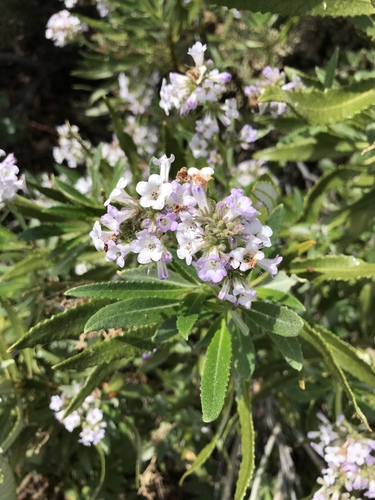
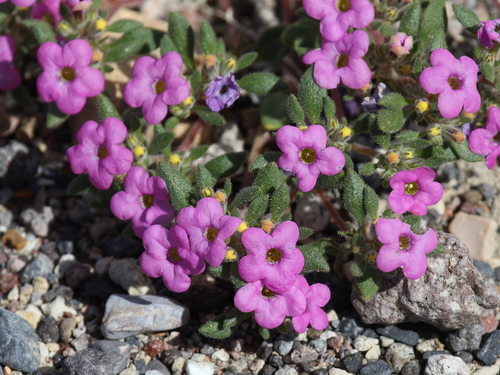
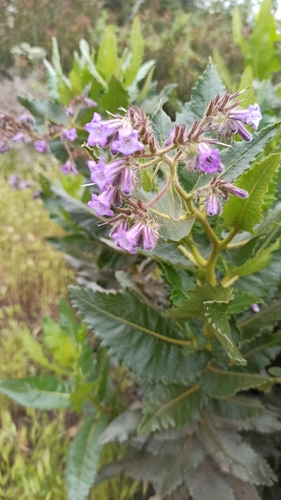
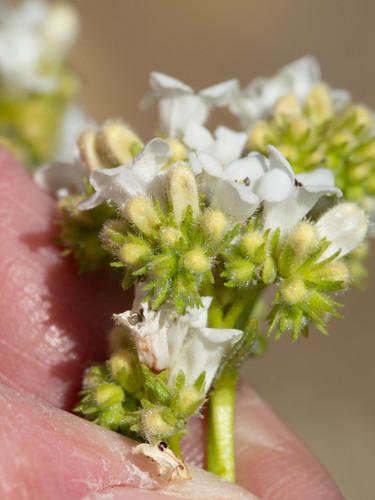
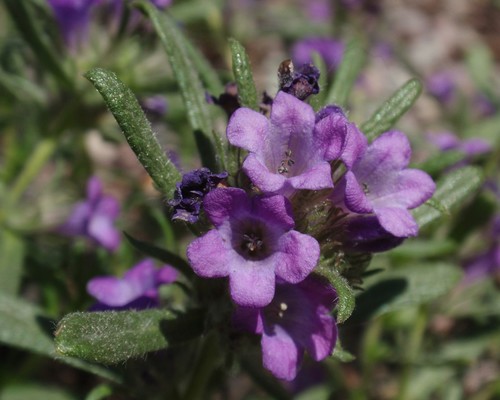
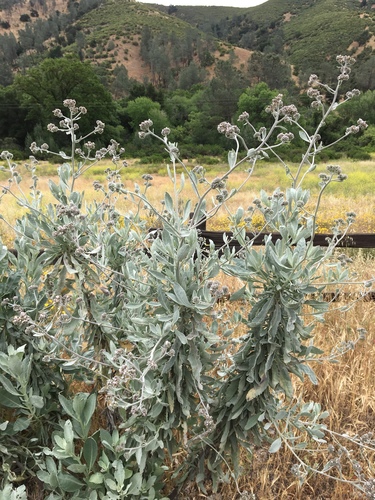
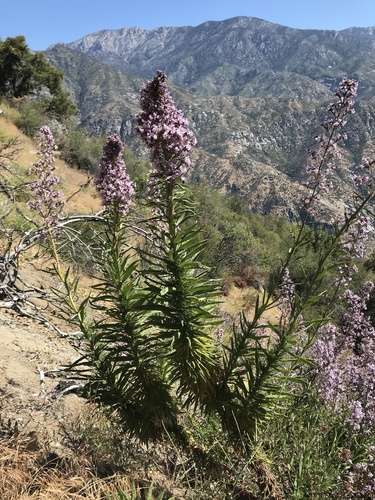
This species, Turricula parryi, is a moderate-sized perennial woody shrub that branches from its base, with main stems reaching up to 2 meters in length. Its leaves are long and narrow, sometimes with toothed edges, ranging from 4 to 30 centimetres (1.6 to 11.8 in) in length. It flowers from June to August, producing clusters (cymes) of attractive bell-shaped flowers that can be blue, lavender, or purple. The plant has a sickly-sweet, minty, or rank scent, even when it is not flowering. For identification, this species' flower clusters and hairy stem are similar to those of many plants in the genus Phacelia, but it can be distinguished by its greater height. It is more difficult to tell apart from other members of its close related group, the yerba santa species Eriodictyon californicum, E. crassifolium, and E. trichocalyx. Their scents are similar, but yerba santa species are not skin irritants and are less specialized for growth in disturbed habitats such as burn areas. Of these plants, Turricula parryi, E. trichocalyx, and E. crassifolium grow mostly south of the latitude of the Monterey/San Luis Obispo county line, while E. californicum grows almost entirely north of that line. This means in many cases, Turricula parryi can be distinguished from yerba santa by its growth location: southern California, in recently disturbed areas. However, yerba santa may grow near or alongside Turricula parryi in disturbed areas. Additional distinguishing features separate yerba santa from Turricula parryi. The flowers of Turricula parryi are thumb-sized, while the flowers of yerba santa are pinkie-sized or smaller. Turricula parryi produces several stems that radiate from a common taproot then grow straight up; each stem is surrounded by thick leaves that form a symmetrical cone. E. trichocalyx has thin, woody, branching stems and tough, leathery, dark green leaves. Turricula parryi is a fast-growing opportunist, and when growing mixed with E. trichocalyx it is often obviously fresher and younger. Yerba santa may grow via crown sprouting in burn areas, while Turricula parryi grows in these areas from seed. As a slower-growing perennial, E. trichocalyx often has leaves that show damage from previous growing seasons. Although both plants can grow to the height of an adult person, E. trichocalyx tends to reach a much smaller stature at higher elevations; rare large plants at these elevations are typically old and woody, with a large tree-like trunk at their base and a large amount of dead wood and twigs. This plant is endemic to southern California and Baja California. In Baja California, it rarely occurs as a fire-following shrub in the southern Sierra de Juarez and the western Sierra de San Pedro Martir. It is particularly common in the Transverse Ranges, and also occurs in the Coast Ranges south of San Luis Obispo, and in the Sierra Nevada as far north as Kings Canyon. It grows in chaparral, on granitic slopes and ridges between 1,000 to 2,300 metres (3,300 to 7,500 ft) in elevation. It thrives in recently disturbed yellow pine forest areas affected by fire or landslides, where it helps prevent erosion and can cover burned hillsides with attractive color. The plant often stays dominant in these areas for around ten years, until saplings and other plants grow back and outcompete it. Its seeds can remain dormant in soil for long periods, and the plant springs back up quickly after the next disturbance. Presumably due to its irritant properties, poodle-dog bush is rarely grown in gardens despite its attractive flowers, and it is difficult to grow under garden conditions.