About Turnix velox (Gould, 1841)
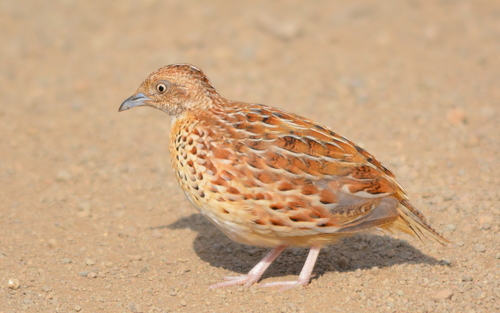
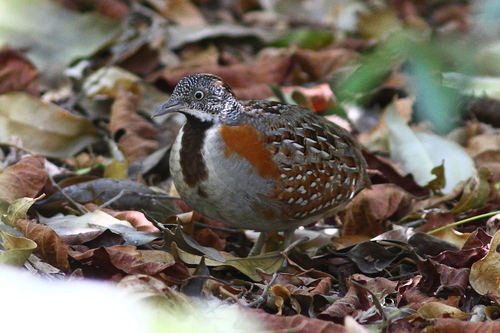
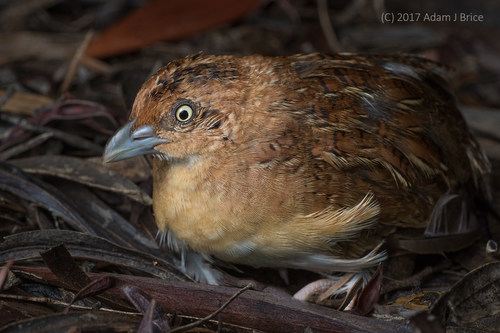
Description: The little buttonquail (scientific name Turnix velox (Gould, 1841)) is a small reddish brown bird with thin white stripes on its upper parts, a blue-grey beak, pink legs and feet, and pale eyes. The female is larger and more brightly coloured than the male. It can be easily distinguished from other small quail. When flying, it has distinctly reddish or pinkish toned upperbody and contrasting tones between different parts of its wings. While it superficially resembles true quails of the genus Coturnix, the little buttonquail differs by lacking a hind toe and a crop. Females also possess a unique vocal organ formed by an enlarged trachea and an inflatable bulb in the esophagus, which is used to produce a booming call. The call patterns of the little buttonquail mainly consist of two key sounds: a loud booming "oo-ah" or "coo-oo", which is usually made at night. When startled, it produces a loud squeaking call made up of several "chip chip-chip" sounds. Distribution and habitat: Little buttonquail are found across most of arid and semi-arid Australia, excluding Tasmania, the Kimberlys region of Western Australia, Arnhem Land in the Northern Territory, and Cape York Peninsula in Northern Queensland. This distribution matches its preferred habitat of grasslands and woodlands in tropical and temperate regions. It is found extensively throughout south and western Australia, and is abundant in much of the Northern Territory. It is extremely rare in higher altitude or coastal areas, and is mainly found in the inland regions of all Australian states. Only one specimen has ever been found in Tasmania. Reproduction and nesting: Unusually, the female little buttonquail is the more brightly coloured sex, and initiates courtship. Little buttonquail are polyandrous: females circulate among multiple males, and aggressively expel all other rival females from their territory. They can breed year-round and produce multiple clutches of eggs, with spring and autumn usually being the most productive. Breeding prevalence is largely dependent on seasonal suitability, with optimum breeding conditions occurring after consistent heavy rain. The little buttonquail nests on the ground in sheltered areas such as small shrubs or overhanging grasses. The nest is created when the nesting pair scratch a small dent in the ground, which is then lined with small sticks or fine grass. Incubation, brooding, and feeding of chicks are all carried out by the male. The eggs are generally off-white with dark brown markings. Incubation typically lasts 12–14 days, and chicks become independent within 3–4 weeks of hatching. Another account notes that eggs hatch after an incubation period of 12 or 13 days, and young are able to fly within two weeks of hatching.