About Turnix nigricollis (J.F.Gmelin, 1789)
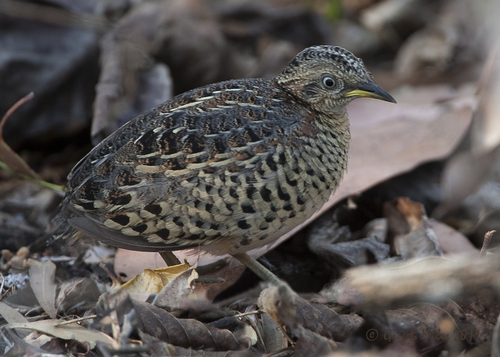
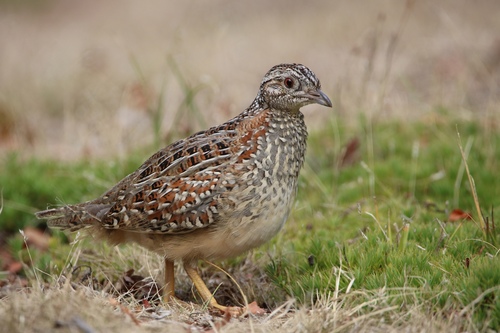
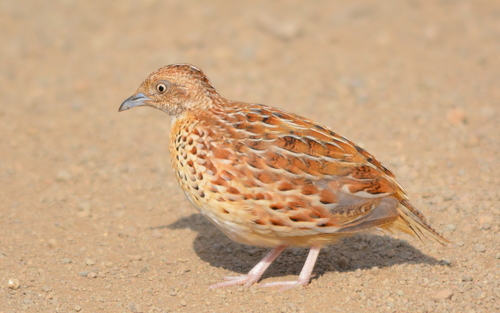
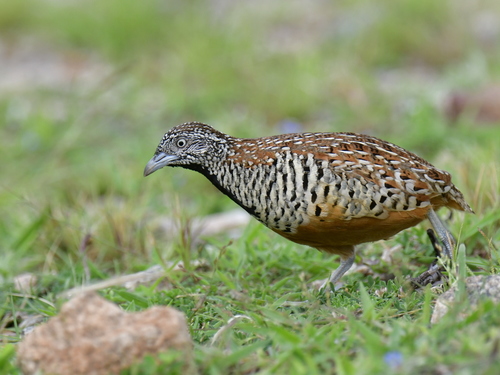
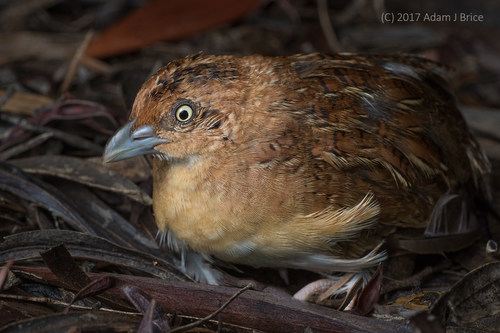
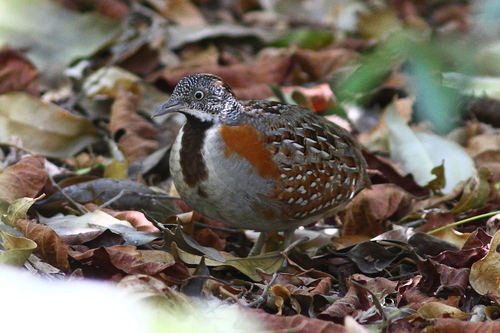
The Madagascar buttonquail, scientifically named Turnix nigricollis, is a stocky bird with a small head, short legs, and a short tail. Both sexes have camouflaged, cryptic coloration, though they differ in appearance. The male has a light brown head marked with black and white streaks and mottling; its back and wings are greyish-brown with fine dark barring and pale-edged feathers, and the barring on its outer scapulars is bolder. Its tail is greyish-brown with fine barring. The male's chin and throat are whitish, its breast is cinnamon-buff with dark barring, and its belly is whitish. It has a bluish-grey bill, white or pale grey irises, and greyish legs. The female is more brightly coloured than the male. The top of the female's head is blackish, and its mantle is brownish-grey with some dark barring and cinnamon feather edges, interspersed with plain grey-brown feathers that create a chequer-board effect. The female has a white moustachial stripe, and below this stripe, its chin and upper throat form a black bib. Its breast is cinnamon-pink, and its belly is grey with faint barring. Juvenile birds resemble males but are slightly darker and more heavily spotted. This buttonquail is endemic to the island of Madagascar, where it occupies most of the island in areas with suitable habitat. It can be found in grassland, open woodland, clearings, glades, forest edges, sandy and bushy locations, weedy areas, and cultivated land, especially cassava-growing areas. It has been introduced to Mauritius, where it is now likely extinct. It is also present on Réunion and the Glorioso Islands, but it is unclear whether it is native to these islands. In terms of behaviour and ecology, the species is most often encountered alone or in small groups of up to four birds. When startled, it may crouch to avoid detection or run away, and it seldom flies unless danger is very close. Even when it does fly, it only travels a short distance with rapid wingbeats. It forages by scratching in plant litter in the same way a chicken does, leaving behind distinctive circular depressions. It feeds mainly on invertebrates, with a particular preference for termite larvae. One individual was recorded to have eaten snails, cockroaches, beetles, flies, true bugs, and caterpillars. It may also consume seeds. Like other species in its family, the female takes the more active role during the breeding season: she defends a territory and produces vocalisations to attract a male. The nest is built in a shallow depression on the ground, often hidden in a grass tussock or thick vegetation. Both birds construct the nest from dried grasses and stems, dead leaves, and sometimes feathers. The nest may be partially roofed with dead leaves, and it is sometimes accessed by a covered runway. The female lays a clutch of about four heavily blotched eggs. The male incubates the eggs for approximately two weeks, and the female may occasionally relieve him during incubation. The male is also responsible for caring for the young, feeding them from his bill for the first week until they begin to peck food from the ground themselves. At first, the female is aggressive toward the chicks, and the male defends them, but the female eventually takes on a greater caring role. Chicks become independent by the fifth week, and the parents may drive them away after this point.