About Turdus torquatus Linnaeus, 1758
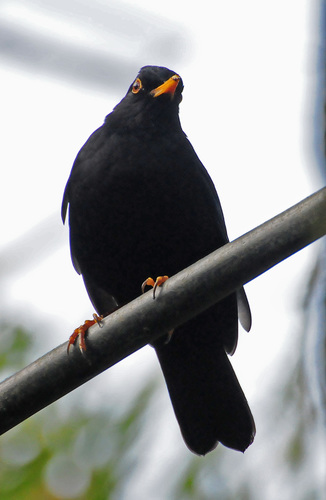
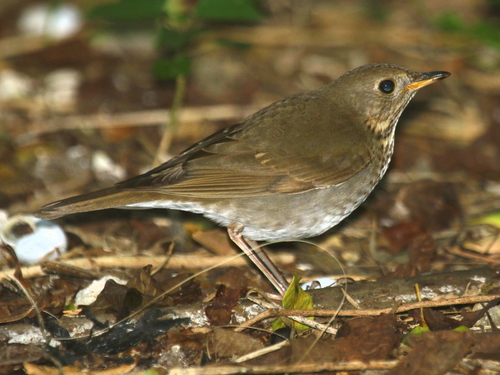
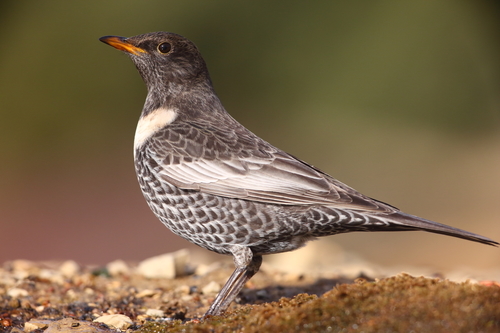
The ring ouzel (Turdus torquatus Linnaeus, 1758) measures 23–24 centimetres (9.1–9.4 in) in length and weighs 90–138 grams (3.2–4.9 oz). For the nominate subspecies, the male's plumage is entirely black with the exception of a prominent white crescent marking on the breast, narrow greyish scaling on the upperparts and belly, and pale edges on the wing feathers. Males have yellow bills and greyish brown legs. Females are similar in pattern to males, but are browner overall and have a duller breast band. Juveniles resemble females, but their breast crescent is faint or entirely absent. Pale breast markings make adult ring ouzels easily identifiable; first-winter males may sometimes also have a pale crescent. Other young ring ouzels can be confused with common blackbirds, but always have a paler wing panel than that species. Males of the subspecies T. t. alpestris have broader white scalloping (small repeated curved markings) on their underparts than the nominate T. t. torquatus, which gives the lower body a distinctly scaly appearance. Their wing panel is also paler than that of the nominate subspecies. Female T. t. alpestris are similar to nominate race females, but have broad white fringes on the chin and throat. Males of T. t. amicorum have the largest and whitest breast band of the three subspecies. The broader white edges and tips of their wing feathers form a distinct whitish panel on the wing. Female T. t. amicorum have narrow white fringes on their underparts. Adult ring ouzels go through a complete moult after breeding, from late June to early September, before their autumn migration. Juveniles undergo a partial moult between July and September, replacing their head, body, and wing covert feathers. The ring ouzel breeds in a discontinuous range across western and northern Europe, from north-west Ireland through Scandinavia to northwest Russia. It also breeds in mountains across central southern Europe, extending from the Pyrenees through the Alps, the Balkans, Greece and Turkey east to Turkmenistan. In 2014, breeding was recorded on the Timan Ridge, Arkhangelsk Oblast, which is around 300 kilometres (190 mi) further east than the previously known northern Russian breeding sites. The species is migratory, with birds leaving their breeding areas in September and October. Nominate subspecies birds winter in southern Spain and northwest Africa. Central European populations of T. t. alpestris move to higher elevations first, before travelling south or southwest through the Swiss Alps; around two weeks later, nominate migrants pass through the same area, to winter in the southern part of the breeding range or around the Mediterranean. Eastern T. t. alpestris migrate through the Balkans and Turkey. T. t. amicorum travels south to winter in Egypt and neighbouring regions. Return migration happens mainly in March and April, with males arriving a few days earlier than females. Northern breeding populations arrive later, and in mountain areas some birds may ascend in stages as snow melts. Many birds stop at traditional, well-grazed grassland sites during both spring and autumn migration. The ring ouzel is extinct in Latvia, and only occurs during migration in Denmark. It is a passage migrant in Syria and a vagrant to Iceland, Jordan, the Arabian Peninsula, Sudan, Kazakhstan, Mauritania, Svalbard and Jan Mayen. In the Atlantic, it is a regular winter visitor to the Canary Islands, but is rare in the Azores and Madeira. At middle latitudes, the ring ouzel inhabits continental mountains, while in the northern part of its range it occurs in coastal uplands. It can tolerate wind and rain, but avoids ice and snow. Nominate T. t. torquatus is most often found on open moorland with a small number of stunted trees, above 250 metres (820 ft), and reaches elevations of 1,200 metres (3,900 ft) in Scotland and northern Europe. In Switzerland, ring ouzels breed on rugged upland slopes with heather, conifers, beech, or hairy alpenrose at 1,100–1,300 metres (3,600–4,300 ft). In Turkey, the species occurs from sea level up to 1,500 metres (4,900 ft). In Armenia and the Caucasus, it occupies similar steep habitat with conifer stands, rhododendron thickets, and juniper scrub and shrubland, ranging from sea level up to 2,000–3,000 metres (6,600–9,800 ft). In northwest Africa, ring ouzels winter in juniper forest at 1,800–2,200 metres (5,900–7,200 ft), often near rivers or ponds. During migration, ring ouzels may be found on coastal grassland and steep hillsides with short, unplanted wild grass and sparse scrub.