About Turdus pilaris Linnaeus, 1758
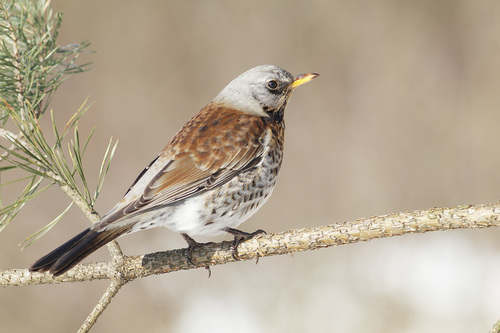
The fieldfare (Turdus pilaris Linnaeus, 1758) is easily recognizable by its slate-grey head, nape, and rump, dark brown back, blackish tail, and boldly speckled breast. In flight, its white under wing-coverts and axillaries are clearly visible, and its harsh "tsak tsak" flight call is also distinctive. For adult males, the forehead and crown are bluish-grey, with each feather bearing a central brownish-black band. The lores and regions under the eyes are black, with faint pale streaks above the eyes. The ear-coverts, nape, hind neck, and rump are bluish-grey; most rump feathers have a white streak near their shaft. Scapular and mantle feathers are dark chestnut-brown, with dark central streaks and pale tips. There are 14 pointed tail feathers total; the outermost two are slightly shorter than the rest, resulting in a rounded tail shape. Tail feathers are brownish-black, with faint darker bars that are only visible in certain lighting. Near the base, the outer edge of each tail feather is fringed with grey, and the outermost pair of tail feathers has a narrow white border along the inner edge. The chin, throat, and upper breast are creamy-buff, marked with bold brownish-black streaks and speckles. The lower breast is creamy-white with a fading buff tinge and fewer speckles, and the belly is also creamy-white, with speckles only present on its uppermost portion. Primaries are brownish-black; the leading edge is fringed with grey, the inner edge of outer primaries is grey near the base, and inner primaries are fringed with brown near the base. Secondaries are similar to primaries, but have chestnut-brown fringes along the leading edge. Upper wing-coverts are brownish-black, with margin coloring matching that of outer primaries. Axillaries and under wing-coverts are white, while under tail-coverts have dark greyish-brown bases and margins, with white centers and tips. The beak is strong, slightly curved, and has a notch near the tip. In winter, the beak is orange-yellow, with the upper mandible somewhat brownish, and the tips of both mandibles brownish-black. In summer, both mandibles of the male's beak are yellow. Irises are dark brown, and legs and feet are brown. Average measurements for adults are: 25 cm (9.8 in) in total length, 14.5 cm (5.7 in) in wing length, 3.5 cm (1.4 in) in tarsal length. Wingspan ranges from 39 to 42 cm, and body weight ranges from 80 to 140 g. Females are very similar to males, but their upper parts are slightly more brownish, crown feathers have narrower black central stripes, the throat and breast are paler, and markings are fewer and smaller. The female's beak matches the appearance of the male's winter beak. Juveniles are duller in color than adults, and have pale streaks on the feathers that bear dark streaks in mature birds. Young fieldfares grow their full adult plumage after their first autumn moult. Fieldfare calls are most often given in flight, and consist of a harsh "tsak tsak tsuk". When groups gather in trees, individuals make the same sound, but softer, for conversational communication. When angry or alarmed, fieldfares produce a variety of warning sounds similar to those of the mistle thrush (Turdus viscivorus). During the breeding season, males sing a rather weak song. It is made up of a few phrases similar to those of the common blackbird (Turdus merula), mixed with whistles, guttural squeaks, and call notes. Males sing this song both while in flight and from perches in trees; a subdued version with more warbling notes is sung by groups of birds at communal roosts. The fieldfare is a migratory species with a Palearctic distribution. It breeds in northern Norway, northern Sweden, Finland, Belgium, Germany, Switzerland, Austria, the Czech Republic, Slovakia, Hungary, Poland, and Siberia, ranging east as far as Transbaikal, the Aldan River, and the Tian Shan Mountains in Northwest China. Its winter range extends through western and southern Europe to North Africa, though it is uncommon in the Mediterranean region. Eastern populations migrate to Anatolia, Lebanon, Iran, and Northwest India, and occasionally reach Northeast India. It occurs as a vagrant in Iceland, Greenland, Spitsbergen, the Canary Islands, the Balearic Islands, Madeira, Corsica, Sardinia, Sicily, the United States, Malta, and Cyprus. Fieldfare flight is slow and direct: birds perform several strong wing beats, then close their wings briefly before resuming flapping. The species is highly gregarious; it is quite shy and easily startled in winter, but bold and noisy during the breeding season. When a group perches in a tree, all individuals tend to face the same direction while maintaining constant chatter. When foraging on the ground, often alongside redwings, the group moves upwind. Each bird pauses occasionally to stand upright and scan its surroundings before returning to feeding. When alarmed, the group flies off downwind, and reforms as a feeding group elsewhere in a new location. Unlike blackbirds or song thrushes, fieldfares do not hide in woodland undergrowth; instead, they perch openly on bushes and high branches. They roost socially, sometimes in overgrown hedges and shrubberies, but most often on the ground. Common roosting sites include rough grass among bushes or clumps of rushes, young plantations, stubble fields, and the furrows of ploughed fields. In summer, the fieldfare occurs in mixed woodland of birch, alder, pine, spruce, and fir, often near marshes, moorland, or other open ground. It does not avoid areas near humans, and can be found in cultivated areas, orchards, parks, and gardens. It also lives on open tundra and on hillsides above the tree line. In winter, groups of fieldfares are found mainly in open country, agricultural land, orchards, and open woodland. They are nomadic, wandering to areas with abundant berries and insects. Later in the winter, they move to pastureland and cultivated fields. The fieldfare is omnivorous. Animal prey in its diet includes snails, slugs, earthworms, spiders, and insects such as beetles and their larvae, flies, and grasshoppers. When berries ripen in autumn, fieldfares eat them in large quantities. They favor berries from hawthorn, holly, rowan, yew, juniper, dog rose, Cotoneaster, Pyracantha, and Berberis. Later in winter, they eat windfall apples, attack swedes growing in fields, and consume grain and seeds. When these food sources are exhausted, or during particularly harsh weather, birds may move to marshes or even the foreshore to feed on molluscs.