About Turdus migratorius Linnaeus, 1766
This species is Turdus migratorius Linnaeus, 1766. All subspecies of this bird share similar size ranges. The nominate eastern subspecies T. m. migratorius measures 23 to 28 cm (9.1 to 11.0 in) in length, with a wingspan of 31 to 41 cm (12 to 16 in). The species has an average weight of around 77 g (2.7 oz); males weigh between 72 and 94 g (2.5 to 3.3 oz), while females weigh between 59 and 91 g (2.1 to 3.2 oz). Standard measurements across the species include a wing chord of 11.5 to 14.5 cm (4.5 to 5.7 in), a culmen of 1.8 to 2.2 cm (0.71 to 0.87 in), and a tarsus of 2.9 to 3.3 cm (1.1 to 1.3 in).
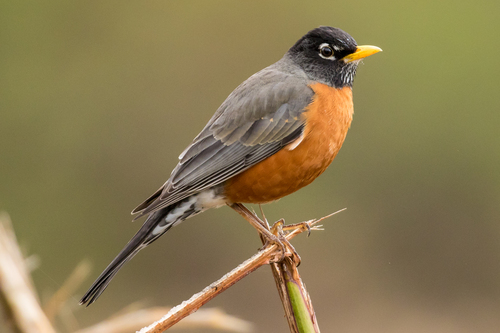
The bird's head ranges in color from jet black to gray, with distinct white eye arcs and white supercilia. Its throat is white with black streaks, and its belly and undertail coverts are white. Adults have a brown back and a reddish-orange breast, which varies in shade from a deep red maroon to peachy orange. The bill is mostly yellow with a variable dark tip; the dark area grows larger in winter. The legs and feet are brown.
Males and females are similar in appearance, but females generally have duller plumage than males, with a brown tint to the head, brown upperparts, and less bright underparts. Some individuals cannot be accurately sexed based on plumage alone. Juveniles are paler than adult males, have dark spots on their breasts, and have whitish wing coverts. First-year birds are not easily told apart from adults, but they are usually duller; first-year males resemble adult females, and a small percentage retain a small number of juvenile wing coverts or other feathers.
This species breeds across most of North America, ranging from Alaska and Canada south to northern Florida and Mexico. While robins occasionally overwinter in the northern United States and southern Canada, most migrate to wintering grounds south of Canada, ranging from Florida and the Gulf Coast to central Mexico, as well as along the Pacific Coast. Most robins leave for the south by the end of August and begin returning north in February and March, with exact dates varying by latitude and climate. Migration distance varies greatly based on the bird's original habitat; one study recorded that individual robins tagged in Alaska travel as much as 3.5 times farther between seasons than robins tagged in Massachusetts.
The species is a rare vagrant to western Europe, with most European records coming from Great Britain, where 29 individuals had been recorded by the end of 2022. It has also occurred as a vagrant in Greenland, Sweden, Jamaica, Hispaniola, Puerto Rico and Belize. Vagrants found in Europe that have been identified to subspecies all belong to the eastern subspecies T. m. migratorius. Greenland vagrant records include the Newfoundland subspecies T. m. nigrideus, and some southern overshot vagrants may belong to the southern subspecies T. m. achrusterus.
The species' breeding habitat is woodland, as well as more open farmland and urban areas. As a breeding species, it becomes less common in the southernmost part of the United States' Deep South, where it prefers large shade trees growing on lawns. Its winter habitat is similar to its breeding habitat, but it includes more open areas.