About Turdus infuscatus (Lafresnaye, 1844)
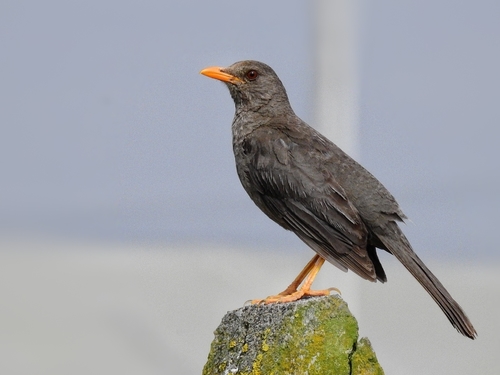
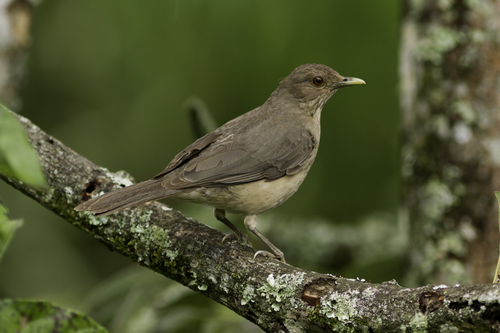
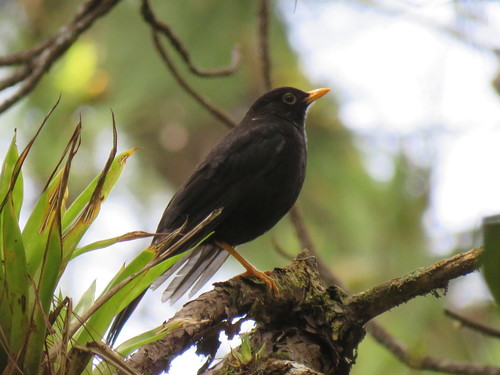
The black thrush, scientific name Turdus infuscatus (Lafresnaye, 1844), measures 22 to 23 cm (8.7 to 9.1 in) long and weighs approximately 60 to 90 g (2.1 to 3.2 oz). This species is sexually dimorphic. Adult males are almost entirely black, with a slightly duller, more slaty belly and undertail coverts, and have a bright yellow ring of bare skin around the eye. Adult females have an olive brown head with dusky brown streaks on the cheeks and a dark brown eye ring. Their upperparts, tail, and the upper surfaces of their wings are olive brown. Their chin and throat are whitish, with dusky brown streaks on the throat. Their underparts are paler olive brown, lightest on the belly and undertail coverts, and their underwing coverts are cinnamon. Juveniles have brown upperparts, and brownish buff underparts marked with black or dusky spots. Individuals of all ages have a dark brown iris. Adult males have a bright yellow bill, while adult females have a blackish bill. Adult individuals of both sexes have bright yellow legs and feet; juveniles have a mostly dark bill and dull yellow legs and feet. The black thrush has a disjunct distribution. It occurs in the Sierra Madre Oriental of eastern Mexico, ranging from Tamaulipas south to Veracruz, and in the Sierra Madre del Sur of western Mexico, ranging from central Guerrero to Chiapas. Vagrants have been recorded in Jalisco, Morelos, and Tabasco. Separate populations exist in west-central Guatemala, El Salvador, and roughly the western half of Honduras. The species was relatively recently discovered in extreme northwestern Nicaragua, and it is unclear whether this discovery represents a range extension or if the species had simply been overlooked in the area previously. The black thrush inhabits montane evergreen forest and pine-oak forest in the subtropical and temperate zones, and also occurs in semi-deciduous forest and cloudforest. Across its full range, it occurs at elevations between 900 and 3,100 m (3,000 and 10,200 ft), and is most common between 1,600 and 2,600 m (5,200 and 8,500 ft). South of Mexico, it ranges between 1,000 and 3,050 m (3,300 and 10,000 ft).