About Turdus cardis Temminck, 1831
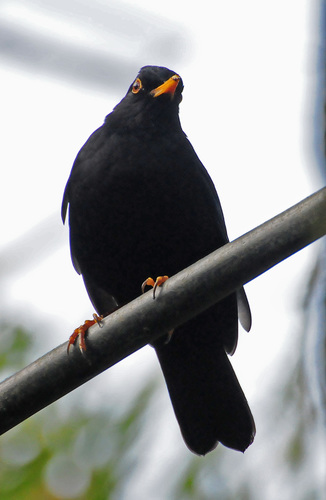
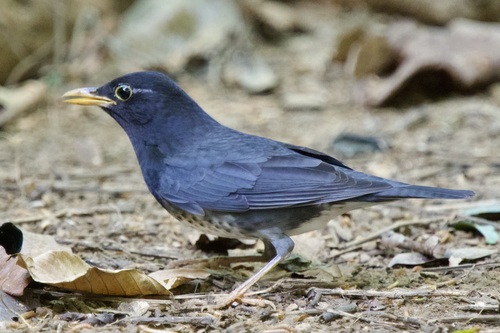
The Japanese thrush (scientific name Turdus cardis Temminck, 1831) is a bird species belonging to the thrush family Turdidae. This species is also commonly called the grey thrush or Japanese grey thrush. It was previously split into two subspecies, with birds breeding in China classified as the subspecies T. c. lateus. Today, however, the observed differences between the two groups are considered to be natural variation, and the species is currently treated as monotypic. The Japanese thrush is a migratory bird. It breeds in central China and Japan, arriving in its Japanese breeding range by April or May. It winters in coastal southern China (including Hainan), northern Laos, and northern Vietnam, departing its breeding grounds around October. It occasionally occurs as a passage migrant in Taiwan, and has been recorded as a vagrant in Thailand. This species typically inhabits forests and woodlands. On its breeding grounds, it occupies deciduous forests or mixed deciduous-coniferous forests, but it can also be found in secondary forest, and even in gardens and parks. The Japanese thrush is a medium-sized thrush. It exhibits sexual dimorphism, meaning males and females have different plumage. Males have black head, breast, back, wings, and tail, with a white underside marked with black spots on the upper belly and flanks. Their legs, bill, and thin eye-ring are yellow. Females are brown on their upperparts, and have a white throat, breast, and belly, with rusty orange wash on the flanks and black spots. Japanese thrushes forage for food on the ground, scratching through leaf litter to find insects and earthworms. They will also eat fruit. The species lays 2 to 5 eggs in a nest constructed from twigs and moss, bound together with mud and lined with hair and rootlets. Eggs are incubated for 12 to 13 days, and chicks remain in the nest for 14 days after hatching. This species is double-brooded, meaning it raises two broods per breeding season: the female lays a new clutch soon after the first brood fledges.