About Turdus atrogularis Jarocki, 1819
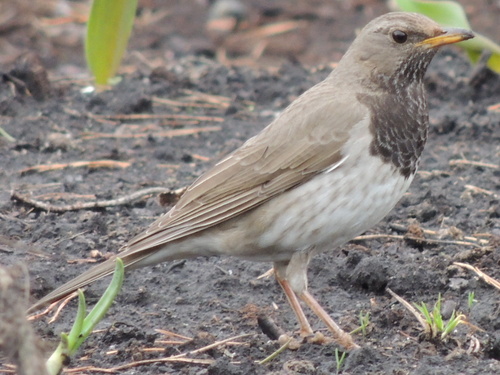
Turdus atrogularis Jarocki, 1819 (black-throated thrush) is a large and distinctive thrush. Males have black coloring from the chin to the breast, with a greyish black tail. Their upperparts are grey, underparts are whitish, and they have orange-red underwing coverts. Females and immatures follow a similar pattern, but the black on the throat and breast is replaced with dusky streaking. Black-throated thrushes breed along clearing edges in coniferous or mixed deciduous forest, often in the undergrowth of Siberian Pine (Pinus sibirica) or mixed spruce fir forest, especially along watercourses or in swampy areas. The breeding range of the black-throated thrush extends from extreme eastern Europe to Western Siberia and north-west Mongolia. Its wintering range stretches from the Middle East (where it is uncommon in the Arabian Peninsula) to eastern Myanmar. As a vagrant, it has been recorded in Japan, Thailand, and Taiwan, and may also occasionally be found in most of Europe west of its normal range. Black-throated thrushes breed either solitarily or in loose aggregations of pairs from late May through to late July. The nest is built from grasses and thin twigs bound with earth, and lined with fine grasses, moss or lichens. The nest is usually placed 1.5 to 2 meters above the ground, and sometimes on the ground. The species' other behaviours are similar to those of the fieldfare T. pilaris. In winter, these thrushes are often found in large flocks with other thrushes: Tickell's thrush T. unicolor, eye-browed thrush T. obscurus and mistle thrush T. viscivorus. During migration they are often seen with dusky thrush. Black-throated thrushes roost in dense evergreen vegetation. They typically feed on the ground. Their diet usually includes invertebrates, and they also feed on various berries, cherries and some seeds.