About Turdoides subrufa (Jerdon, 1839)
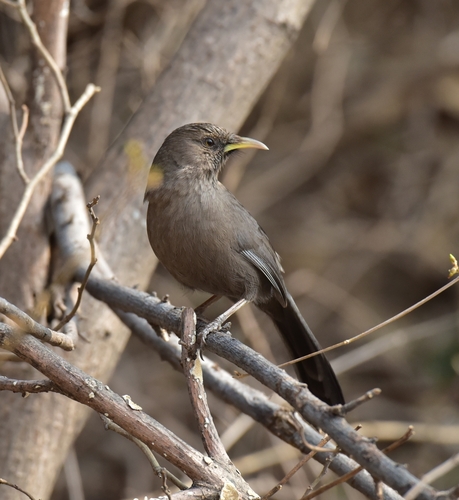
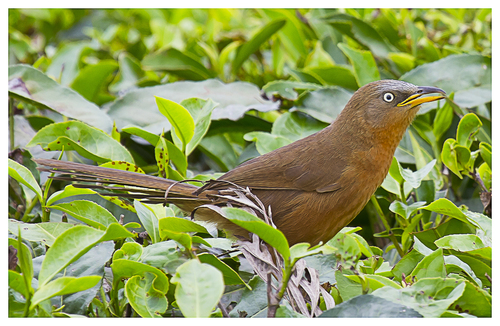
This species, Turdoides subrufa (Jerdon, 1839), is a large babbler. Individuals have dark olive brown upperparts, a grey forehead, and black shafts on the forehead feathers. Wing feathers carry a rufous tinge. Their iris ranges from pale white to yellow, and their lores are dark. The underside is bright rufous, with paler coloration at the center of the throat and belly. The species reaches a total length of 25–26 cm; the wing measures 8.7-9.0 cm, and the tail measures approximately 11–11.5 cm. Two subspecies are recognized: the nominate form, with a type location at Mananthawadi, occurs in the Western Ghats north of the Palghat Gap, while the subspecies hyperythra, found to the south of the gap, is reported to be more richly coloured. Turdoides subrufa is distributed across the Western Ghats from south of Mahabaleshwar south to the Palni hills, and extends east into the Shevaroy hills. It typically stays close to the ground, though it will also use trees, and feeds on insects and berries. Its common habitats are open forest, scrub, and grassy hillsides. The main breeding season for this species runs from February to November. It builds a small cup-shaped nest in the fork of a tree. Clutches contain two to four eggs, most often three, which are dark glossy blue. Its call is a loud, ringing treenh-treenh.