About Turdoides striata (Dumont, 1823)
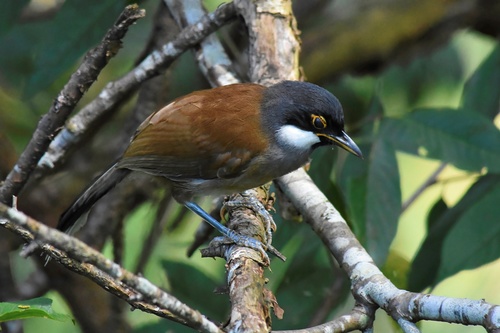
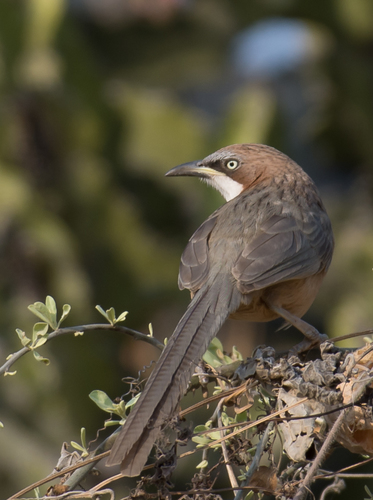
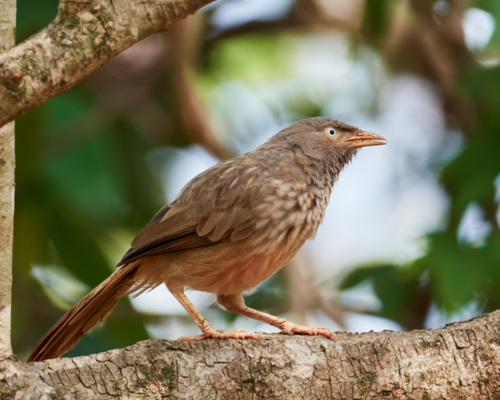
Jungle babbler (Turdoides striata) lives in forest and cultivation habitats. Like most babblers, this species is non-migratory, with short rounded wings and weak flight. Both sexes look identical: they have drab brownish-grey plumage and a yellow bill, making them easily confused only with the endemic yellow-billed babblers of peninsular India and Sri Lanka. Their upper parts are usually slightly darker in shade, and there is some mottling on the throat and breast. The subspecies Turdoides striata somervillei found in Maharashtra has a very rufous tail and dark primary flight feathers. Jungle babblers can be distinguished from white-headed babblers by their dark loreal area between the bill and eye, and by the lack of a contrasting light crown. The calls of the two species are also distinct and unmistakable: jungle babblers have harsh nasal calls, while white-headed babblers produce high pitched calls. Another babbler species that occurs in the same urban areas as the jungle babbler is the large grey babbler, but this species has a distinctive long tail with white outer tail feathers. Jungle babblers live in flocks of seven to ten or more individuals. They are noisy birds, and the presence of a flock can usually be detected from some distance away by the harsh mewing calls, continual chattering, squeaking, and chirping produced by flock members. Jungle babblers are gregarious and highly social. They sometimes form the core of a mixed-species foraging flock. They feed mainly on insects, but also eat grains, nectar, and berries. Flocks maintain territories and will defend them against neighboring flocks, though neighbors are sometimes tolerated. For their body size, jungle babblers are long lived, and have been recorded living up to 16.5 years in captivity. When foraging, some individuals take up a high vantage point to act as sentinels. They are known to gather together and mob potential predators such as snakes. A study of their activity budget found that jungle babblers have greater similarity to social primates than to other comparable bird species. Young jungle babblers have a dark iris, while older birds have a pale creamy-colored iris. This color change occurs because the iris has a dark epithelium that becomes invisible when muscle fibers develop in the iris, hiding the dark basal color and making the iris appear cream-colored. They breed throughout the year, with peak breeding seasons in northern India recorded between March–April and July–September. Individuals reach sexual maturity after their third year. The nest is built halfway up a tree, concealed in dense masses of foliage. The normal clutch size is three or four deep greenish blue eggs, though clutches can be as large as seven. In northern India, birds breeding during July–September are often parasitized by the pied crested cuckoo, and sometimes by the common hawk-cuckoo. Helper birds assist the breeding parents in feeding the young. Post-fledging survival rates are very high. After fledging, females typically leave their natal group after about two years. Birds within a group often engage in allopreening, play chases, and mock fights. When threatened by predators, they have been reported to sometimes feign death.