About Turdoides rufescens (Blyth, 1847)
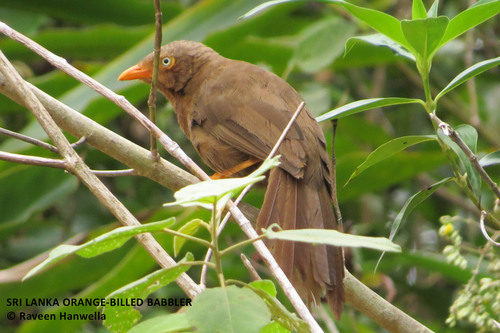
The orange-billed babbler, also called Ceylon rufous babbler or Sri Lankan rufous babbler, is classified under the family Leiothrichidae. Its scientific name is also cited as Argya rufescens, alongside the basionym Turdoides rufescens published by Blyth in 1847. This species is a resident breeding bird endemic to Sri Lanka. Historically, it was treated as a subspecies race of the jungle babbler Argya striata. Its primary habitat is rainforest, and it is almost never found outside of deep jungle areas. Like most babbler species, it is non-migratory, has short rounded wings, and has weak flight ability. Even though its rainforest habitat is currently under threat, the species is found across all forests in Sri Lanka’s wet zone, and it is fairly common in well-preserved prime sites including Kitulgala and Sinharaja. It constructs its nest in trees, hidden within thick dense foliage. A typical clutch contains two or three deep greenish blue eggs. In terms of plumage, the underparts of these birds are a plain orange brown, while the upperparts are a slightly darker shade. The crown and nape are grey, and the bill is orange. Orange-billed babblers live in flocks of seven to ten or more individuals. They are a very noisy species, and the presence of a flock can usually be detected from some distance away by the constant chattering, squeaking, and chirping produced by flock members. This species is often the first indicator that a mixed-species feeding flock — a common feature of Asian wet forests — is nearby. It feeds mainly on insects, but will also eat jungle berries.