About Turdoides affinis (Jerdon, 1845)
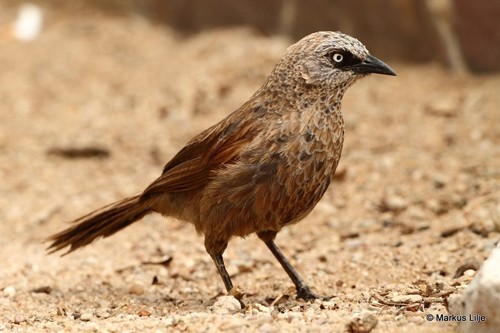
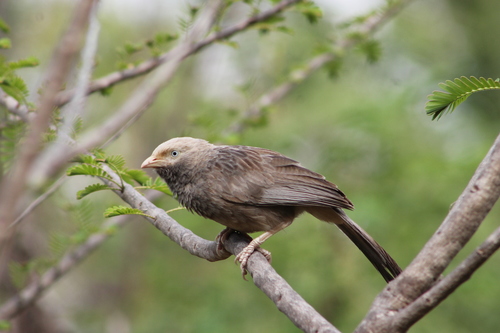
Turdoides affinis (Jerdon, 1845) individuals have grey-brown upperparts, a grey throat and breast with some mottling, and a pale buff belly. Their head and nape are grey, and their eyes are bluish white. The nominate race, found in southern India, has a whitish crown and nape, with a darker mantle. The rump is pale and the tail has a broad dark tip. The Sri Lankan subspecies A. a. taprobanus is drab pale grey. Birds in the extreme south of India are very similar to the Sri Lankan subspecies; the colour of their crown and back is more grey than the nominate race. The Indian form has heavier streaking on the throat and breast. The Sri Lankan subspecies resembles the jungle babbler, Turdoides striatus, although that species does not occur on Sri Lanka. Seven distinctive vocalisations have been recorded for this species, which has a higher pitched call than the jungle babbler. Jungle babbler calls have a harsher and more nasal quality. The taxonomy of this species was confused in the past, and it was historically confounded with the sympatric jungle babbler and the orange-billed babbler of Sri Lanka.
This species is patchily distributed in southern India and Sri Lanka. The nominate subspecies occurs in Andhra Pradesh south of the Godavari river, and in Karnataka south of Belgaum extending into Tamil Nadu. It prefers lower altitudes and drier habitats than the jungle babbler, but is sometimes found alongside that species. The Sri Lankan subspecies is found in lowlands and hills up to about 1,500 m (4,900 ft), and avoids heavy forest. It is a common garden bird that frequently visits urban and suburban areas.
Yellow-billed babblers live in flocks of seven to ten or more individuals. They are very noisy, and a flock can typically be detected from some distance by the constant chattering, squeaking and chirping from its members. Occasionally, all members chattering together becomes loud enough to significantly irritate human hearing. One flock member often perches high up to act as a sentinel, while the rest of the flock forages on or close to the ground. They feed mainly on insects, but also eat fruit, nectar and human food scraps. They have been recorded eating Calotes versicolor lizards and whip-scorpions. They do not fly long distances; the maximum recorded non-stop flight distance is about 180 m (590 ft), and they usually gain height by moving up a tree or tall shrub before flying. Black drongos, rufous treepies and Indian palm squirrels are often seen foraging near these babblers. Babblers wake before dawn around 6:00 AM and begin foraging. They are relatively inactive during the hot midday hours between 1:30 PM and 4:30 PM. They assemble in groups around 7:00 PM and preen themselves before roosting. Group members roost next to each other, with juveniles typically wedging themselves in the center of the roosting group. When foraging, the sentinel bird calls while fluttering its wings and hopping. Allopreening is a common activity, particularly in winter, and group members may beg for food from other members. Yellow-billed babblers particularly enjoy bathing, and may visit birdbaths within their home ranges, usually in late afternoon or evening. They have sometimes been observed visiting birdbaths around 6:30 PM, after sunset. A study conducted on the Sivakasi plains found that groups had a 0.4 km² home range, and the population density was around 55 birds per km².