About Turbo saxosus W.Wood, 1828
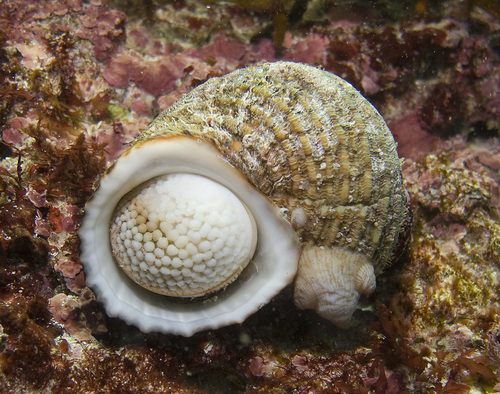
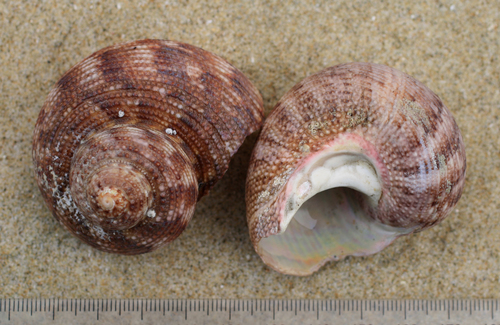
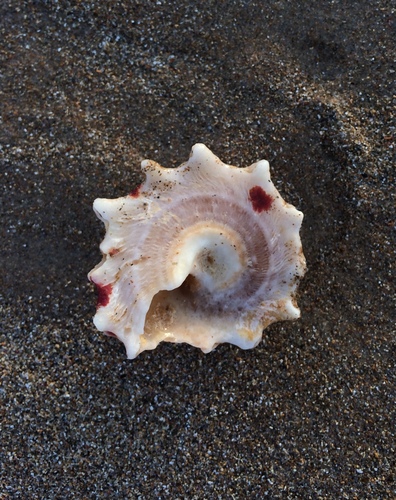
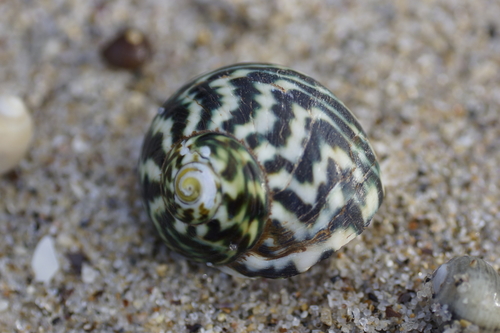
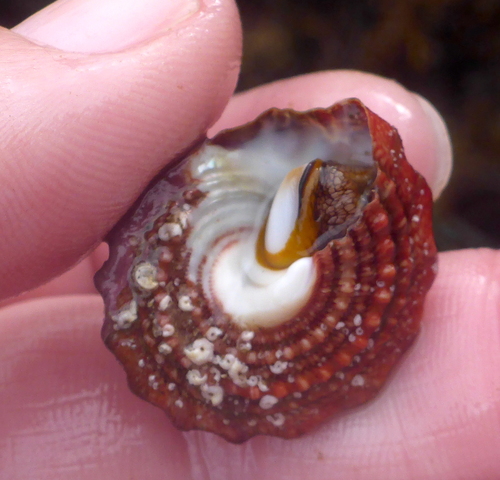
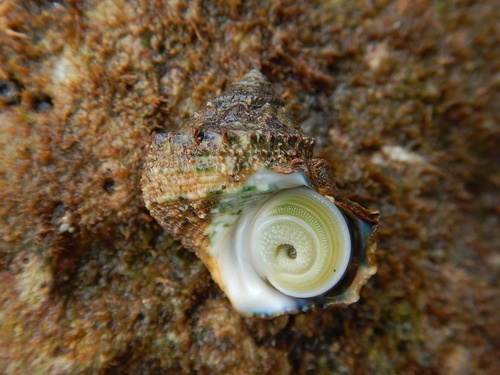
Turbo saxosus W.Wood, 1828 is an extremely variable species of marine gastropod. The length of its adult shell ranges from 20 mm to 54 mm. The shell is imperforate and has an ovate-conic shape. Shell color varies, and may be brown, olive, or gray. The upper shell surface is marked with radiating patterns, while the lower surface is irregularly spotted with snowy white. Some dark, unicolored specimens also exist. The conic spire is acute, and the suture is canaliculate. The shell has 5 to 6 whorls, which are densely lamellosely striate and spirally irregularly lirate. The whorls are carinated, usually more or less nodose at the shoulder, and bear a subsutural series of stout erect tubercles. The rounded aperture is equal to half the total length of the shell, and it is white and iridescent on the inside. The arched columella is callous and concave; it has a deep semilunar longitudinal groove and is slightly produced at its base. The operculum is rounded oval, flat and dark chestnut on the inside, with four or five whorls and a subcentral nucleus. The outer surface of the operculum is convex and white, with a coarsely granulose middle portion, a deep narrow central pit, and a bounding deep concentric furrow that is not continuous over the margin of increment. Outside this furrow sit three narrow, minutely beaded concentric ridges, and the margin of increment itself is granulose. Frequent variations include a form with several tuberculate lirae encircling the shell base; in this strongly nodose variety, incremental striae are usually inconspicuous. A second common form has spiral lirae that are not noticeably tuberculate. This species occurs in the Pacific Ocean, ranging from Panama to Peru.