About Turbo sarmaticus Linnaeus, 1758
Scientific name: Turbo sarmaticus Linnaeus, 1758
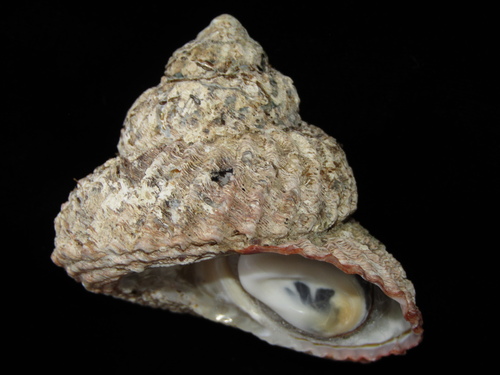
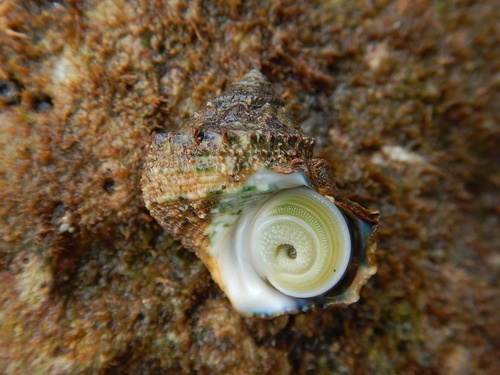
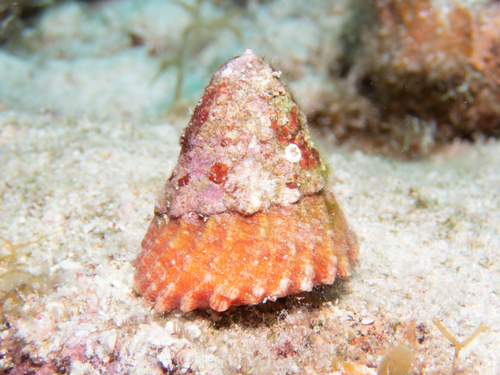
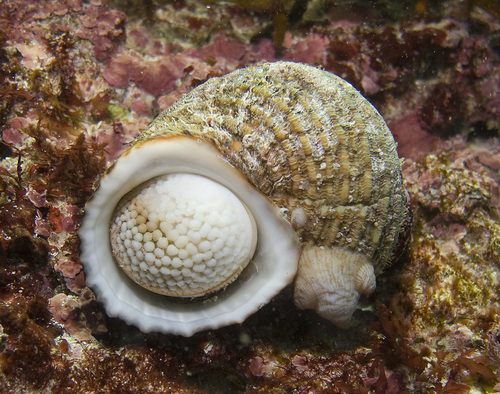
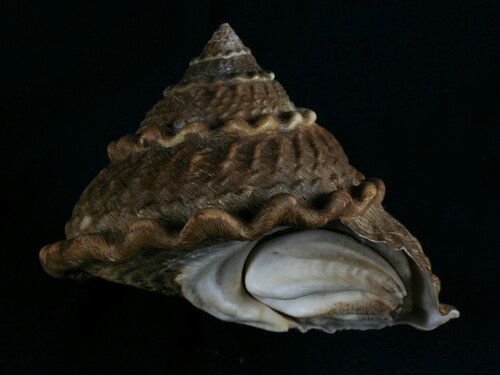
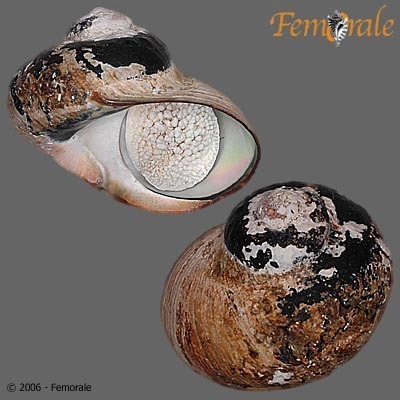
Description. The length of the shell of this species ranges from 40 mm to 120 mm. The shell is imperforate and has a globose-depressed shape. Its overall color is dull brownish; it is flammulated on the upper portion, and more or less banded or spotted with white on the lower portion. A layer of underlying orange-red is usually visible through the outer color; between this orange-red layer and the inner nacre lies a layer of intense black. The very short spire is conical. There are 5 to 6 whorls, which are convex except for their upper portions, which are concave. The upper whorls have revolving lirae, and are frequently keeled. The last whorl is crossed by several rows of nodules; the row at the shoulder (coronal row) is the most prominent and consistent. The large, round aperture is very slanted, and beautifully lined with nacre on the inside. The outer lip is thin, and edged with intense black on the inside; the nacre does not reach all the way to the lip edge. The curved columella is wide, slightly extended downward, and broadly hollowed on its upper portion. The parietal wall is eroded, revealing a black patch. The operculum is flat on its inner face, has 5 to 6 whorls, and has a submedian nucleus. Its outer surface is convex and whitish, and the exterior side is covered with calcareous pustules.
Distribution. This marine species is abundant, and is most often found off the south coast of South Africa.