About Turbo fluctuosus W.Wood, 1828
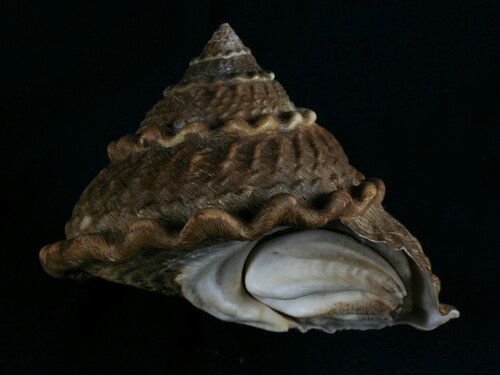
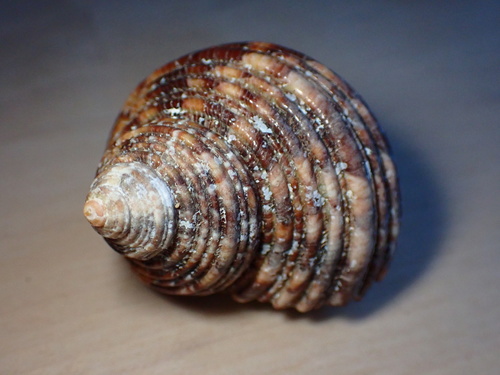
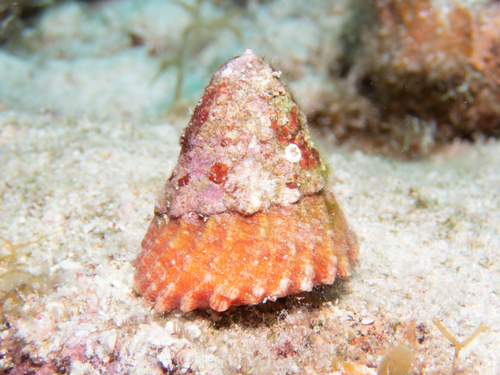
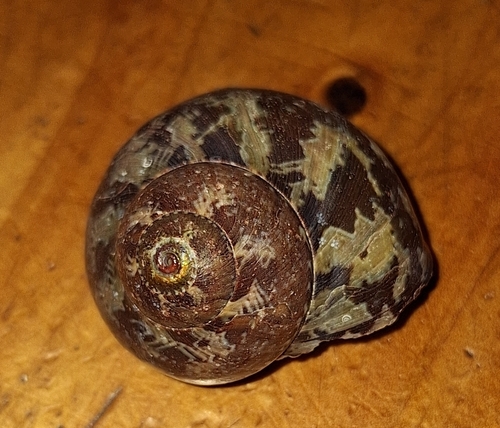
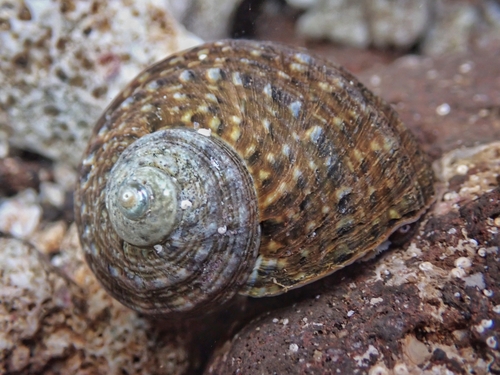
This species is Turbo fluctuosus W.Wood, 1828. The shell of this species ranges in length from 25 mm to 86 mm. The shell is short, solid, and imperforate, with an ovate-conic shape and a conic spire. Its color can be olivaceous, green, brown, or grayish, with longitudinal streaks or white tessellated patterns. There are five whorls, which are typically angulate and nodose at the shoulder. The median and lower portions of the body whorl have a variable number of coarse, subnodose revolving carinae, along with intermediate lirulae. The large aperture is iridescent on the inside. The wide columella is white, slightly produced at the base, and has a longitudinal excavation or groove on its face. The operculum is a rounded oval shape, with four whorls and a subcentral nucleus. The outer surface of the operculum is convex. The central portion of the operculum is elevated, white, sharply granulate, and bounded by a wide groove. This groove connects to a deep central pit via a lunate channel. Outside this groove is a zone that holds around six narrow concentric beaded green lirulae, which are not continuous across the side of increment. This species is distributed in the Pacific Ocean, from the Baja California peninsula to Peru, and also occurs off the Galapagos archipelago.