About Turbo castanea Gmelin, 1791
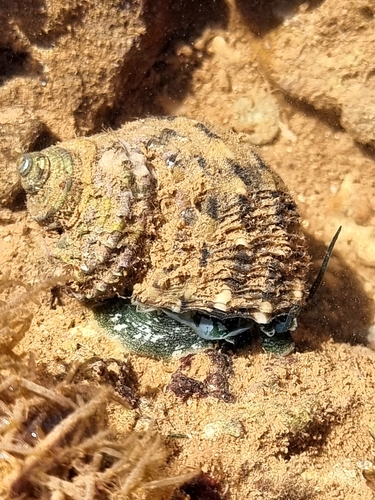
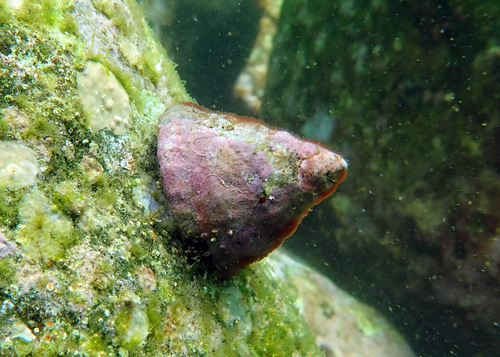
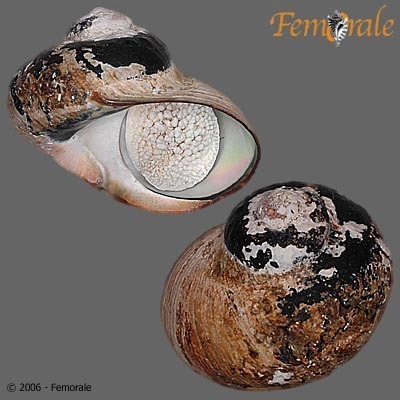
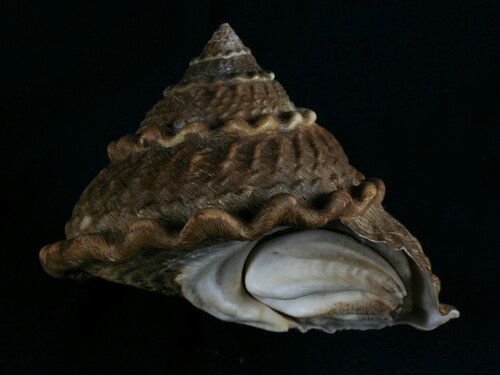
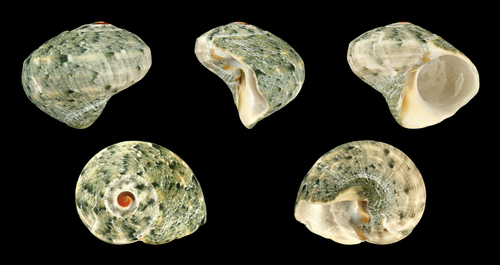
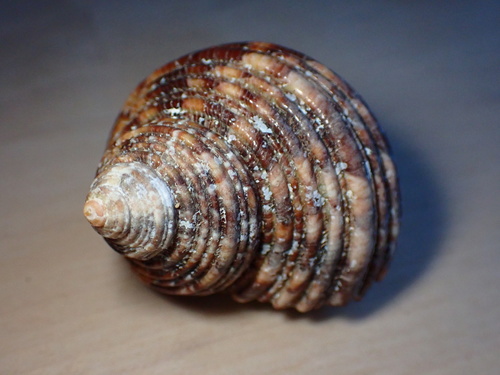
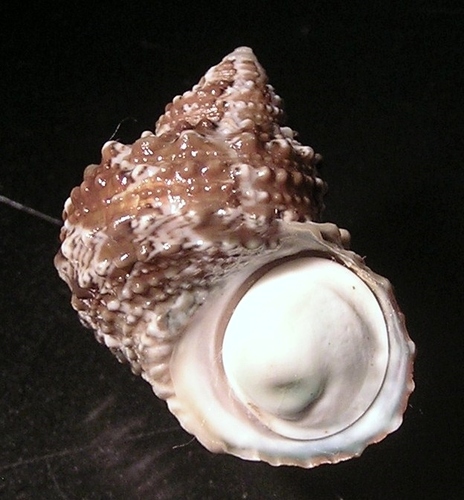
Turbo castanea Gmelin, 1791 has a maximum recorded shell length of 55 mm. It is an abundant species that varies in both color and the prominence of its shell sculpture. The solid, imperforate shell of this species has an ovate-conic shape. Shell color ranges from orange to brown or gray; individuals may sometimes show bands, flame-shaped markings, or spots of white or brown. The conic spire is acute, and the suture is subcanaliculate. The species has 5 to 6 convex whorls that are somewhat flattened in their middle section. The whorls are ornamented with numerous unequal spiral granose, spinose, or squamose lirae; the subsutural lira and three to four submedian lirae are more prominent than the others. The typical form of this species has very sharp sculpture, and the principal lirae occasionally bear vaulted scales. The white aperture is subcircular, and is subangular at the upper edge. There is no umbilicus. The peristome is slightly produced below. The columella features a heavy white callus. The operculum is chestnut-brown on the inner side, with four rapidly increasing whorls. Its nucleus is positioned one-third of the distance across the operculum face. The outer surface of the operculum is convex and nearly smooth, and may be white, or stained with brown and green around its middle. The known distribution of Turbo castanea covers Aruba, Belize, Bonaire, the Caribbean Sea, the Cayman Islands, Colombia, Costa Rica, Cuba, Curaçao, the Gulf of Mexico, Hispaniola, Jamaica, Mexico, Panama, Puerto Rico, and Venezuela; it also occurs in the Atlantic Ocean from North Carolina to Brazil. The species occupies habitats from a minimum recorded depth of 0 m to a maximum recorded depth of 141 m.