About Turbinellus kauffmanii (A.H.Sm.) Giachini
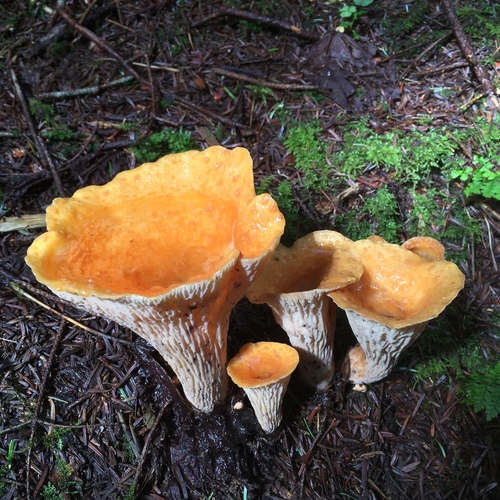
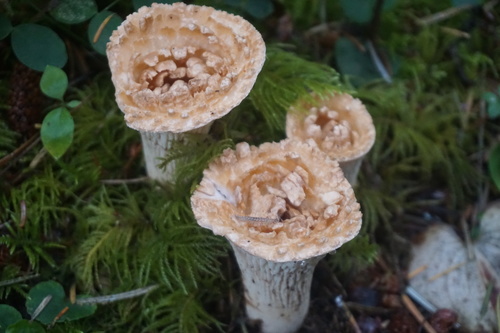
The fruitbody of Turbinellus kauffmanii is vase-shaped overall. The cap is usually 10–20 cm (4–8 inches) in diameter, rarely reaching up to 35 cm (14 inches) across. Cap color ranges from olive to brown; as the mushroom ages, the cap surface splits into olive to clay-colored scales, with white flesh visible between the scales. The flesh itself is thick and white. The spore-bearing hymenium is decurrently attached to the stipe. When young, this spore-bearing surface is yellow, and it ages to a buff-pink color; bruising younger specimens produces a wine-colored stain. The stipe is normally 8–15 cm (3–6 inches) tall and 2–4 cm (3⁄4–1+1⁄2 inches) wide, but can grow as tall as 40 cm (15+1⁄2 inches). The spore print of Turbinellus kauffmanii is ochre-colored. Young specimens have a pungent smell, and their flesh can have an acrid taste. Laboratory experiments confirm that T. kauffmanii contains norcaperatic acid, though at lower concentrations than found in Turbinellus floccosus. Norcaperatic acid increases muscle tone in the smooth muscle of the small bowel (ileum) of guinea pigs. When administered to rats, the compound causes mydriasis, skeletal muscle weakness, and central nervous system depression. It is thought to be the agent responsible for the toxic gastrointestinal symptoms caused by consumption of T. floccosus. Turbinellus kauffmanii is native to the Pacific Northwest and northern California, where it grows in coniferous forests on humus-rich soil. Fruitbodies are more common during warm, wet summers. It has also been recorded growing in Amanalco municipality, central Mexico.