About Turbinellus floccosus (Schwein.) Earle ex Giachini & Castellano
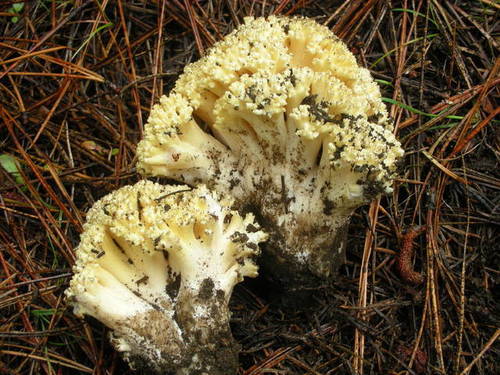
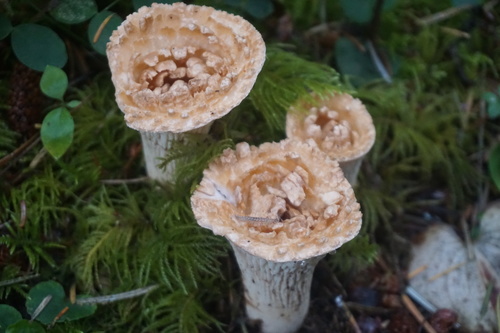
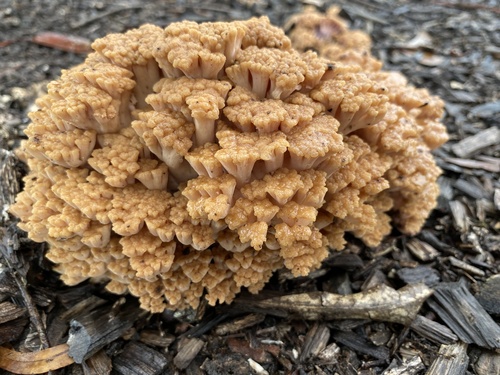
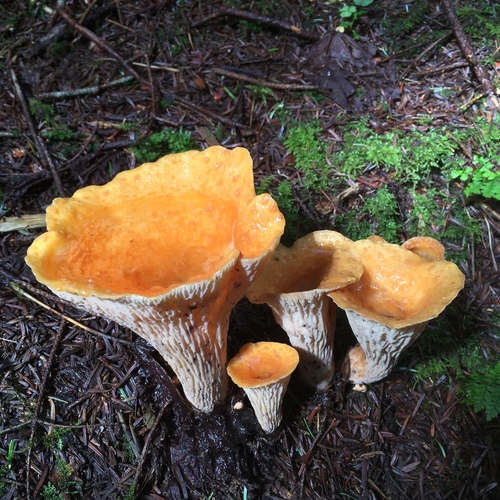
Description: Adult fruit bodies of Turbinellus floccosus start out cylindrical, and mature into trumpet- or vase-shaped forms, reaching up to 30 cm (12 in) in both height and width. There is no clear separation between the cap and stipe. The stipe can grow up to 15 cm (6 in) tall and 6 cm (2+1⁄2 in) wide, and tapers to a narrower base. It is solid in young specimens, but older specimens are often hollowed out by insect larvae. At higher elevations, two or three fruit bodies may grow from a single stipe. The fungus is colored in various shades from reddish- to yellowish-orange; the cap surface is split into scales, with the spaces between scales being more yellow and the scales themselves more orange. The most vibrantly colored specimens grow in warm humid weather, and older specimens are often paler. The white flesh is fibrous and thick, but becomes thinner with age. It is somewhat brittle, and can sometimes turn brown when cut or bruised. Its smell has been reported as either indistinct, or "earthy and sweet", and its taste is reported as "sweet and sour". The spore-bearing undersurface is irregularly folded, forked, or ridged rather than gilled, and is pale buff, yellowish, or whitish in color. These ridges reach up to 4 mm (1⁄8 in) high, and are decurrent — they extend below and run irregularly down the cap's attachment to the stipe. The spore print is brownish, and spores are ellipsoid, with dimensions of 12.4–16.8 × 5.8–7.3 μm. The spore surface is roughened with ornamentations that can be viewed under a microscope after staining with methyl blue. Fruit bodies can persist for a fairly long time, growing slowly over a month. Mushrooms growing in subalpine and alpine areas are typically stocky with a short stipe, as their growth is slower in cold climates. This form also appears at lower altitudes during colder seasons, and was named forma rainierensis by Smith. In contrast, mushrooms growing at low altitudes, such as in redwood forests, can grow and expand rapidly, with large caps that have prominent scales. Smith described a paler form with a solid stipe from the Sierra Nevada as forma wilsonii. American mycologist R. H. Petersen described an olive-capped form that is otherwise identical to the typical form. None of these forms are recognized as distinct taxa. Distribution and habitat: This fungus forms ectomycorrhizal (symbiotic) relationships with various conifers, including Douglas-fir (Pseudotsuga menziesii), multiple fir (Abies) species (momi fir Abies firma, European silver fir A. alba, and Khinghan fir A. nephrolepis), multiple pine (Pinus) species including Pinus densiflora, and western hemlock (Tsuga heterophylla). In Mexico, T. floccosus associates with Abies religiosa, and the mycorrhizal association between these two species has been successfully produced in controlled laboratory conditions. T. floccosus is more abundant in older tree stands and locations where there is more decomposed wood on the forest floor. The species occurs in coniferous forests across North America, particularly in western North American states during late summer and autumn. It is most abundant in rainy regions of the Pacific Northwest, northern California, and the Sierra Nevada. It also occurs across Asia, and has been recorded from Japan, North Korea, China, Tibet, India, Nepal, and Pakistan. It has been occasionally recorded from introduced conifer plantations in Australia. Toxicity and uses: Turbinellus floccosus is poisonous to some people who eat it, but other people have consumed it with no ill effects. Consumption can cause nausea, vomiting, and diarrhea, and these symptoms are sometimes delayed for 8–14 hours. A tricarboxylic acid called α-tetradecylcitric acid may be responsible for the severe gastrointestinal symptoms. Laboratory experiments have shown this compound increases tone in the smooth muscle of the guinea pig small bowel (ileum); when administered to rats, it caused mydriasis, skeletal muscle weakness, and central nervous system depression. Turbinellus floccosus contains more than double the amount of this acid than the related species T. kauffmanii. Despite its toxicity, T. floccosus is one of the ten most widely consumed wild mushrooms eaten by ethnic tribes in Meghalaya, northeast India, and is highly regarded by the Sherpa people near Sagarmatha National Park in Nepal. It is not known whether Indian populations of T. floccosus are nontoxic, or if local people have developed immunity to its toxins. The mushroom is also eaten in Mexico. American mycologist David Arora reported that some people enjoy eating it, while he found it had a strong sour taste. The fruit bodies of T. floccosus produce oxylipins (lipids formed by oxygenation of fatty acids) that are active against the fungal plant pathogens Colletotrichum fragariae, C. gloeosporioides, and C. acutatum. In standard laboratory testing, extracts of the fungus have shown antimicrobial activity against several strains of human pathogenic microbes. T. floccosus also contains pistillarin, a dicatecholspermidine derivative that inhibits DNA damage caused by hydroxyl radicals generated from the Fenton reaction. Pistillarin is the compound that causes a green color when iron salts are applied to the surface of the fruit body.