About Turbinella angulata (Lightfoot, 1786)
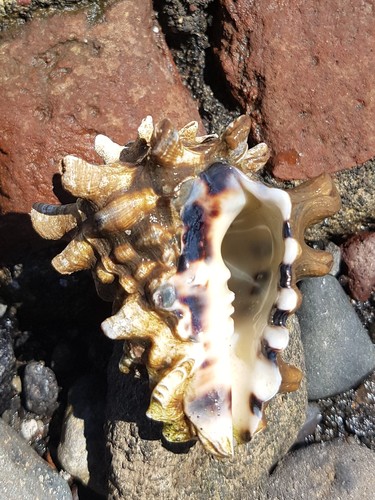
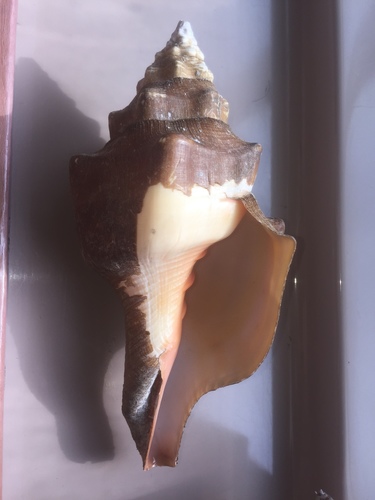
Turbinella angulata, commonly known as the West Indian chank, has shells that grow to between 12.7 and 49.6 centimetres (5.0–19.5 inches). These large shells are heavy and fusiform in shape, with a sculpture made up of 8 to 10 prominent ribs that are angled at the shoulder. The columella of the shell has three distinct strong folds. The basic outer colour of the shell is white, while the inner aperture may be pink or orange. This species occurs in the Western Atlantic Ocean. Its range extends from the Florida Keys and the Bahamas southward to Cuba, the Dominican Republic, Jamaica and Haiti, and it is also found along the Caribbean coasts of Mexico, Belize, Honduras, Nicaragua, Costa Rica, Panama and Colombia. These large reef-associated gastropods live in tropical environments. They occur in subtidal areas, offshore mud flats, rock beds, sand beds, and mangrove lagoons, at depths ranging from 0 to 45 metres.