About Turbinaria reniformis Bernard, 1896
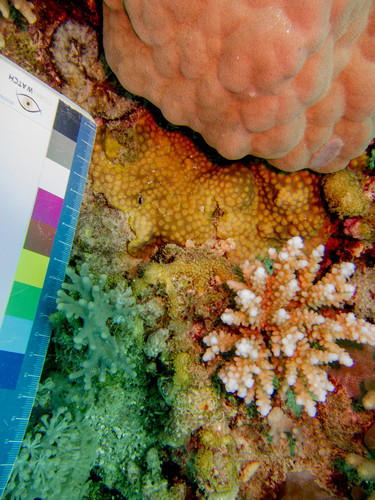
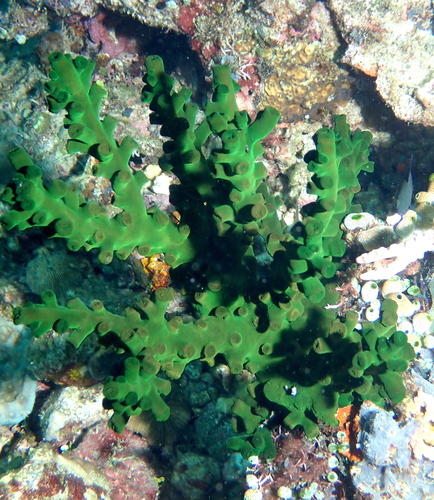
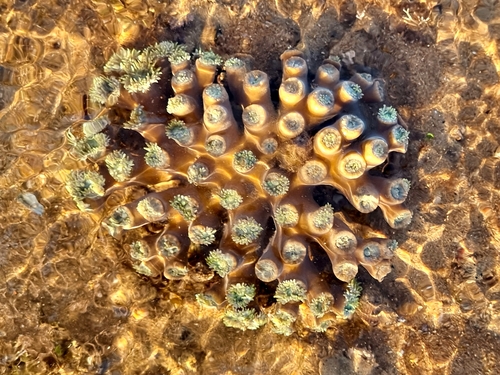
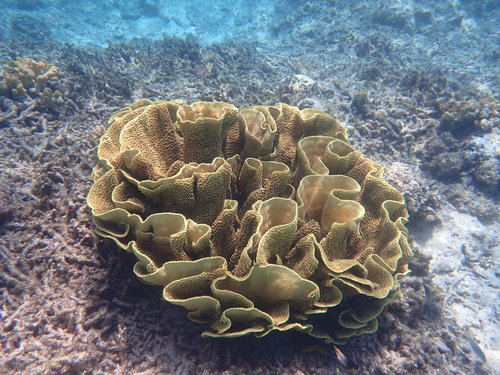
Turbinaria reniformis Bernard, 1896 is a laminar coral species. It forms horizontal plates, shallow chalices, and sometimes forms tiers. Corallites, the skeletal cups that hold coral polyps, are only located on the upper side of the plates and are widely spaced. These corallites range from 1.5 to 2 mm (0.06 to 0.08 in) in diameter, have thick walls, and are either sunk into the coenosteum (skeletal tissue) or conical in shape. This species has a distinct corallite-free rim, and is usually yellowish-green in colour. Turbinaria reniformis has an extremely wide distribution, with its range extending from the Red Sea and the Gulf of Aden, through the Indian Ocean and central Indo-Pacific, to northern Australia, southern Japan, the South China Sea, and island groups in the West and Central Pacific. Turbinaria reniformis is a zooxanthellate coral that lives in symbiosis with unicellular dinoflagellates called zooxanthellae. These photosynthetic protists supply their host coral with nutrients and energy, so this coral requires relatively shallow water and bright lighting to gain this benefit. When exposed to thermal stress, the coral may expel its zooxanthellae, become bleached, and eventually die. Research has found that when surrounding seawater is moderately enriched with nitrogen, this coral is better able to withstand thermal stress and retain its zooxanthellae. T. reniformis is gonochoristic: each colony is either male or female. Breeding occurs synchronously, with all colonies in an area releasing their gametes into the sea around one week after the full moon in November.