About Tupaia tana Raffles, 1821
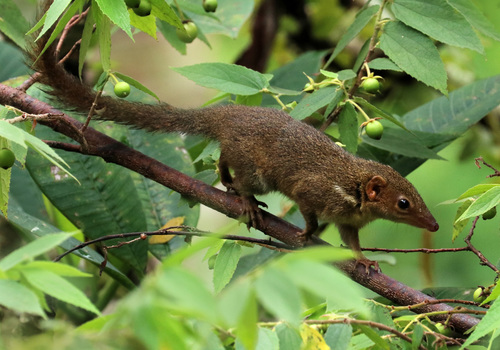
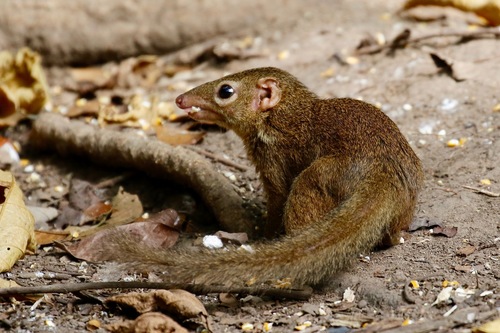
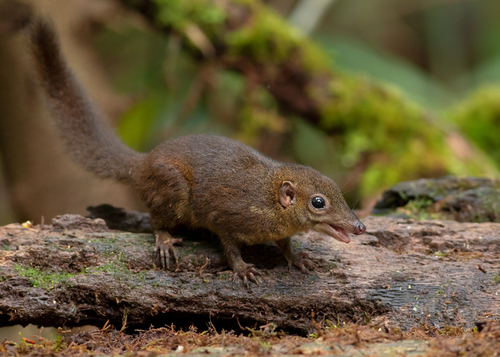
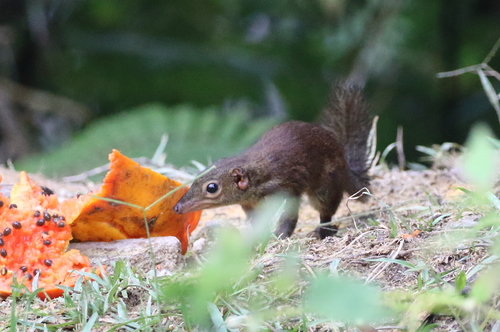
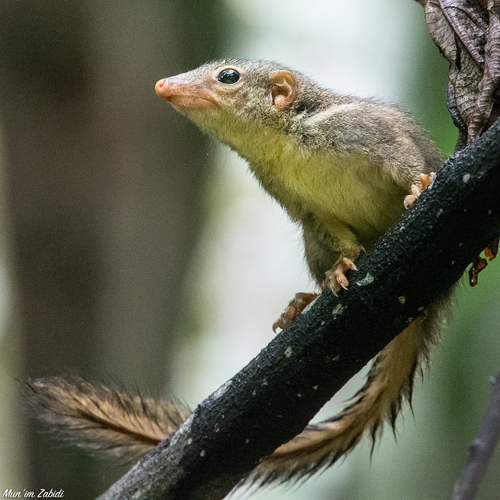
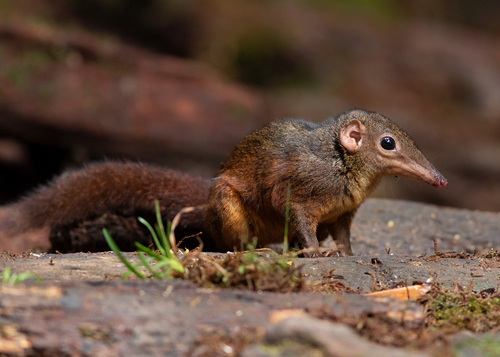
Tupaia tana (large treeshrew) is slightly larger than the common treeshrew (T. glis). Its dorsal fur is reddish brown, fading to nearly black toward the rear. A black stripe runs from the neck between half and two-thirds of the way down the back, where it disappears into the darker fur of the posterior body. Published body size measurements for the species are as follows: head and body length ranges from 165–321 mm (6.5–12.6 in); tail length ranges from 130–220 mm (5.1–8.7 in); hind foot length ranges from 43–57 mm (1.7–2.2 in); and body weight ranges from 154–305 g (5.4–10.8 oz). The species has a long snout: in adult individuals, the distance from the center of the eye to the tip of the muzzle is more than 37 mm (1.5 in). Tupaia tana has sensitive hearing and large eyes that give it acute night vision but poor daylight vision. Tupaia tana is the most predominantly terrestrial of all treeshrew species. Individuals are usually found on the forest floor, which is their primary foraging location, though they do spend part of their time in trees. Field observations and morphological traits both support the classification of this species as mainly terrestrial. Large treeshrews are most abundant in primary tropical rainforest, but also occur in swamp forest and secondary growth forest. Documented potential predators of T. tana include the marbled cat, leopard, and clouded leopard. In their lowland rainforest ecosystem, large treeshrews help maintain the ecosystem by dispersing seeds. On average, both male and female large treeshrews reach reproductive maturity around one year of age. Females almost always give birth to two altricial young. Female fecundity is reduced when individuals occupy poor-quality territories, or during periods when resources are scarce.