About Tulosesus impatiens (Fr.) D.Wächt. & A.Melzer
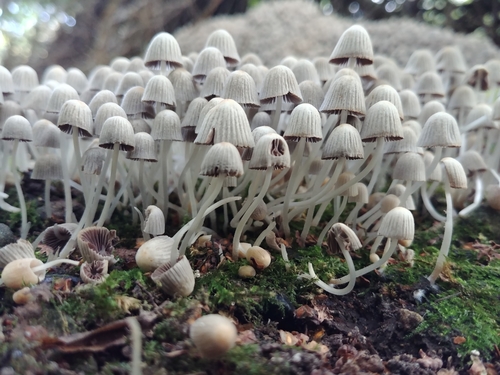
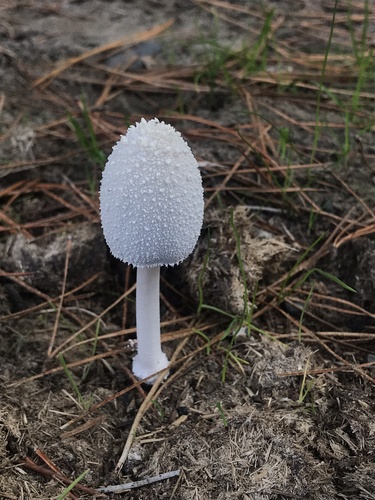
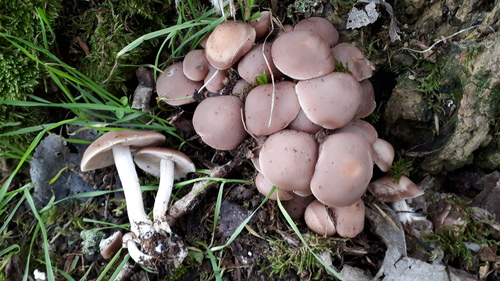
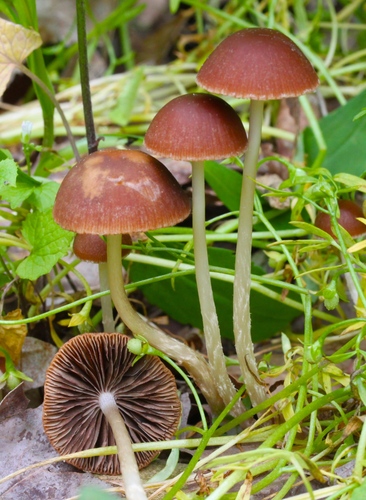
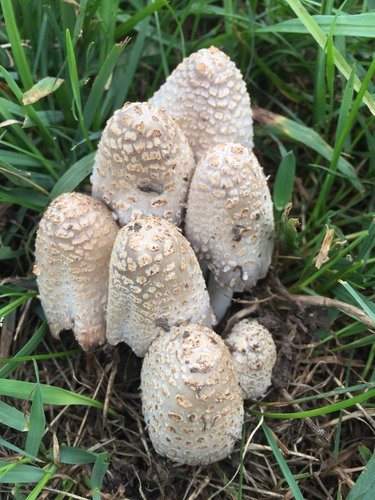
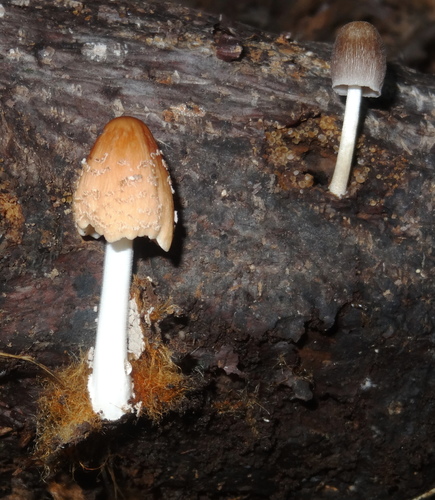
The fruit bodies of Tulosesus impatiens have caps that start out egg-shaped, then become conical to convex before eventually flattening. Mature caps reach 1.8 to 4 cm (0.71 to 1.57 in) in diameter, with deep, narrow grooves that extend almost to the cap center. The cap surface is pale buff, and becomes tawny or cinnamon toward the center; the color fades when the mushroom dries. The flesh is whitish, thin, fragile, and only barely deliquescent (able to auto-digest). Gills are buff when young, turning grayish brown as they mature, and are either free (not attached to the stem) or adnexed, with only a small portion of the gill attached to the stem. The stem is whitish, very slender, roughly equal in width along its length, or slightly thicker at the base. It measures 7 to 10 cm (2.8 to 3.9 in) long and 0.2 to 0.4 cm (0.08 to 0.16 in) thick. Young stems have a pruinose surface, coated in a fine layer of tiny white particles; this coating eventually sloughs off, leaving a smooth or silky surface. The odor and taste of the fruit bodies are not distinctive. The gills of this species do not autodigest with age, or only do so barely, and fruit bodies tend to become more fragile as they age. The spore print is dark brown. Spores are smooth, ellipsoid or almond-shaped, with a germ pore, and measure 9–12 by 5–6 μm. The spore-bearing cells, called basidia, are four-spored and tetramorphic, meaning spores sit on several different levels and mature at different times. Cheilocystidia, cystidia located on the gill edge, are either roughly spherical (20–35 μm broad) or flask-shaped (lageniform, 36–64 by 10–15 μm), with an often rather acute apex around 3–5 μm wide. Pleurocystidia, cystidia located on the gill face, are absent from this species. Tulosesus impatiens is distributed across North America and Europe (including Germany, Poland, and Ukraine), and also occurs in northern Turkey. In the Pacific Northwest region of the United States, it is found in Oregon and Idaho. Its fruit bodies grow singly, or more rarely in small clusters, on forest litter in deciduous forests, particularly those dominated by beech.