About Tulipa suaveolens Roth
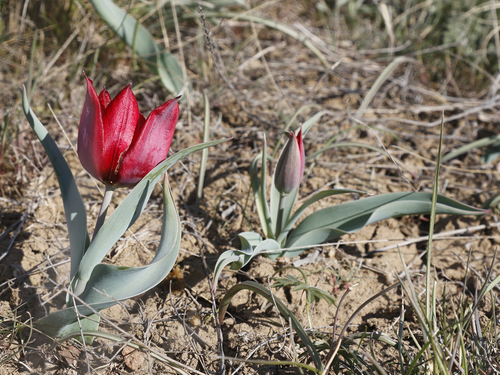
Tulipa suaveolens Roth has a dark brown bulb tunic with stiff hairs growing on its inner surface, particularly towards the tip. It produces three to four glaucous, undulate leaves. The leaves are normally 10 cm long, sometimes reaching up to 20 cm in length, and measure 3–6 cm in width. Its stem is 15–30 cm long, glabrous, and sometimes slightly hairy. The flowers are bowl-shaped and vary widely in colour, including red, light-red, pink, mauve, yellow, or white; some forms have red petals bordered with yellow or white.
Tulipa suaveolens inhabits the Eurasian steppe. Its confirmed distribution includes southern and eastern Ukraine, Crimea, the European part of Russia (specifically the lower Don region, around the Sea of Azov, south-eastern Voronezh Oblast, most of Volgograd Oblast and Saratov Oblast, southern Samara Oblast, and Orenburg Oblast), most of Ciscaucasia (extending south to North-Ossetia, Kabardino-Balkaria, the former Chechen-Ingush region, Terek, and northern Dagestan), western and northern Kazakhstan, the lowlands of western Siberia, Central Asia, and China. It also occurs locally in western Iran and Azerbaijan. The status of populations in Anatolia is dubious, as they may be descended from plants previously cultivated in gardens and parks. Different taxonomic treatments for this group of wild tulips differ: Gerhard Pils only lists Tulipa sylvestris, Tulipa humilis, Tulipa saxatilis and Tulipa armena as wild species, while Christenhuit et al. assume there are approximately seven wild species, but do not list them. Tulipa schrenckii, a related steppe species, grows in meadows and lawns of the Eurasian steppe, where it can form dense, widespread flower stands; it also sometimes grows in semideserts, at elevations up to 600 m above sea level. This tulip (Tulipa suaveolens) is a protected species in Russia and Kazakhstan.