About Tulipa kaufmanniana Regel
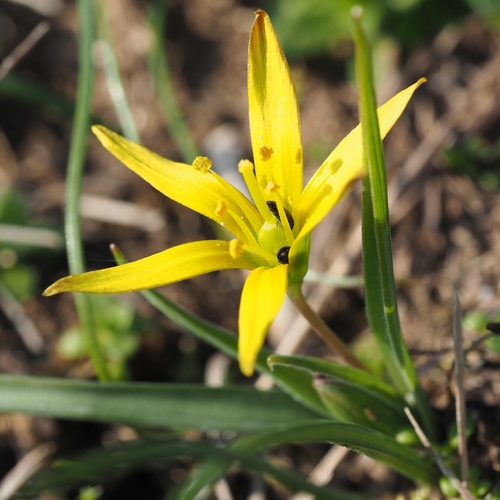
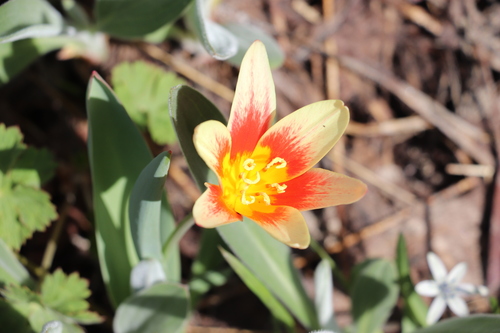
This dwarf tulip species has a short stem, measuring 20–25 cm (8–10 in) in length. Its leaves are lance-shaped, and can be plain green or blue-green; purple leaf markings are also common. It is one of the earliest blooming tulip species, flowering between February and April. Its flowers are funnel-shaped, with six pointed petals that open outward in a star shape similar to water lilies, a trait that inspired its common name. On sunny days, the flowers open very widely. Typically, the outer petals of the flower are a different color than the inner petals. The long, upright petals often have an orange-red, red, or purple flushed area on the petal back. The inner petal surface may have a butter-yellow or yellow blotch, sometimes with additional red markings. Flower color forms also exist in solid red, orange, pink, and clear yellow. After flowering, this species produces seeds. Tulipa kaufmanniana is native to temperate regions of Central Asia. It has become naturalized across southern Europe, North Africa, and Asia, ranging from Anatolia and Iran in the west to northeast China. In its native range, it occurs in Kyrgyzstan, Tajikistan, and Kazakhstan, as well as in the Tien-Shan, Pamir, and Hindu Kush mountains. In the wild, T. kaufmanniana grows on stony hillsides and steppes. This species is suited for cultivation in rock gardens, garden beds, and garden borders. It grows well in USDA Growing Zones 3 to 8, planted in full sun, in soils with medium moisture retention or well-drained soils. Research on seed germination of this tulip found that 7 weeks of stratification was more effective for the tested growth traits than 5 weeks of stratification. In addition, cold stratification was a more effective treatment for breaking seed dormancy in this species.