About Tulipa alberti Regel
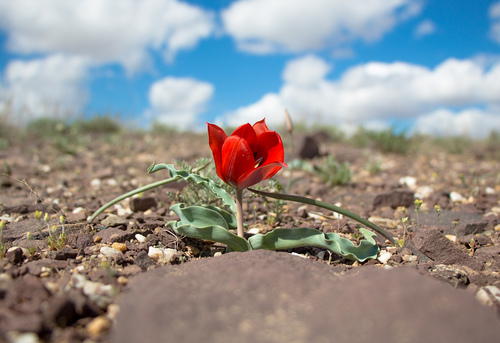
Tulipa alberti Regel has an ovoid bulb that measures 4 cm (2 in) in diameter. Its stem is erect, glaucous, and grows 18–20 cm (7–8 in) tall. The plant produces 3 to 4 broad, glaucous green leaves that have no blotches; the leaves are either lanceolate (lance-shaped) or crispate (curled). The basal leaf is roughly 14 cm (6 in) long and around 6 cm (2 in) wide, while other leaves measure up to 11 cm (4 in) long by 2.3 cm (1 in) wide and have an undulated or wavy texture. It bears a single solitary flower that blooms in mid-spring, during the month of April. The flower is cup-shaped, similar in shape to the flowers of Tulipa greigii or Tulipa armena. Blossom colors range from orange with a reddish tint, to solid orange, orange-pink, red, and dark claret, with an occasional yellow form occurring. The flower has three inner petals and three outer petals. Normally, the three inner tepals of T. alberti are obtuse and folded inward, while the three outer tepals are sub-acute and folded outward. The outer tepals are 8 cm (3 in) long and 6 cm (2 in) wide. The petals have a distinct blotch at the base, which is either lemon yellow, or yellow with a margin of red-brown, dark purple, or black. Rare yellow forms of both T. greigii and T. alberti can have a crimson blotch on the inner side of the petal. The plant’s stamens are 2.9 cm long total, with small yellow filaments 1.4 cm long. Anthers are roughly the same length as the filaments, and are dark purple, or sometimes yellow in pale-colored flower forms. It has an erect, pubescent peduncle that is 6–8 inches (152–203 mm) long. After flowering, it produces a seed capsule. It has a light green, cylindrical ovary that is 2.2 cm long and 0.7 cm wide. The seed capsule is ovoid with a tapering top, and measures 4.3 cm long and 2.5 cm wide. Inside the capsule are bright brown, sub-triangular seeds that are 0.6 cm long and 0.5 cm wide.
Tulipa alberti Regel is native to temperate regions of Central Asia (also called Middle Asia). It can be found in Kazakhstan, Kyrgyzstan near Lake Balkhash, and Uzbekistan, growing across the Tien Shan mountains that span all three countries. It grows alongside other tulip species including Tulipa kaufmanniana and what was previously called Tulipa zenaidae, now classified as a synonym of Tulipa lehmanniana Merckl. Its native habitat is gravelly slopes.