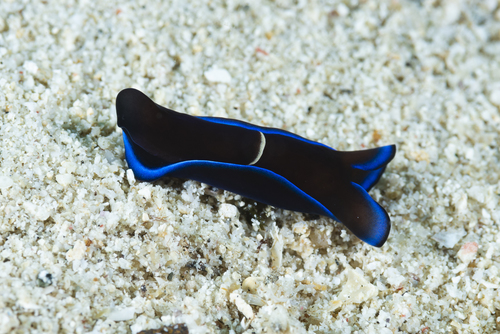
About Tubulophilinopsis gardineri (Eliot, 1903)
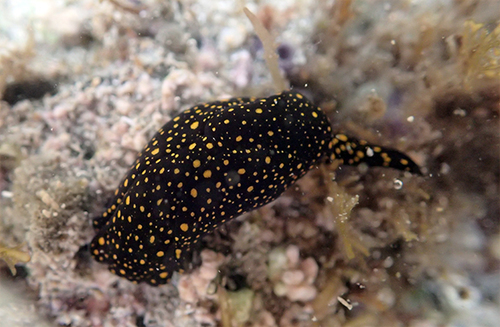
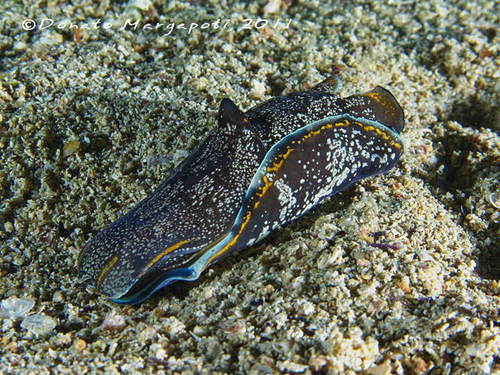
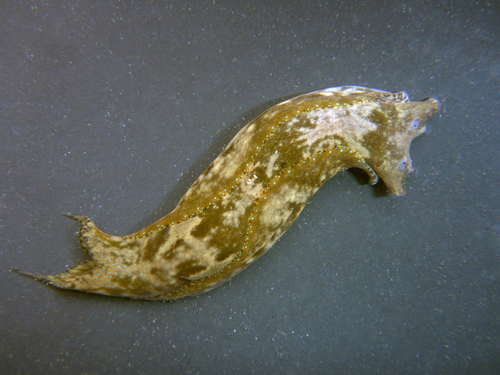
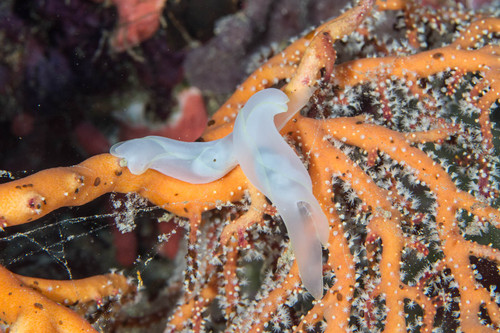
Tubulophilinopsis gardineri is a moderately large sea slug that reaches an approximate length of 70 mm (3 in). It is relatively broad for its length, and has a broad headshield with a distinct hump. The headshield has a pointed posterior end, but this end can look almost straight when the slug is moving. The headshield is used for digging and burrowing into the substrate. Behind the headshield lies a body shield that holds the remnants of a thin shell, and has two rounded lobes at its posterior end. On each side of the body are lateral outgrowths called parapodia, which curve inward toward the center of the body. The coloration of this sea slug is very distinctive: it is dark brown or black, with a thin, bright blue border along its shields, posterior lobes and parapodia. A small number of white or yellow lines sometimes appear on the dorsal surface of the body. This species can be mistaken for Chelidonura varians, which has very similar coloration, but C. varians has its body shield posterior lobes extended into long pointed tips, with the left tip always longer than the right. Another similar species is Philinopsis speciosa, but this species lacks the distinctive head hump, and has a noticeable pointed extension at the posterior end of its headshield. Tubulophilinopsis gardineri is native to shallow waters of the Indo-Pacific region, with a range extending from South Africa and Tanzania to Japan and Fiji. It inhabits sandy or muddy substrates, and occurs at depths down to approximately 10 m (33 ft). All members of the family Aglajidae are predators. Tubulophilinopsis gardineri is diurnal and likely feeds on polychaete worms and other sea slugs. It can move quite quickly, and can follow the mucus trail left by a sea slug, detecting the trail using sensory hairs next to its mouth. It has no radula, but can evert its mouth cavity to suck up prey; the retracted mouth cavity forms the hump on the slug's head. Like other members of Aglajidae, this sea slug is a hermaphrodite. After two individuals meet, they transfer sperm to one another simultaneously. Their egg masses hold between 5,000 and 70,000 eggs arranged in strands, clumped together into a balloon-shaped mass that is anchored to the substrate by a mucus filament. The eggs hatch after four to ten days.