About Tubuca coarctata (H.Milne Edwards, 1852)
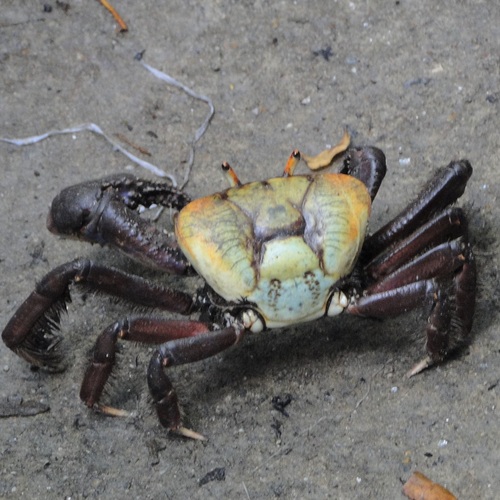
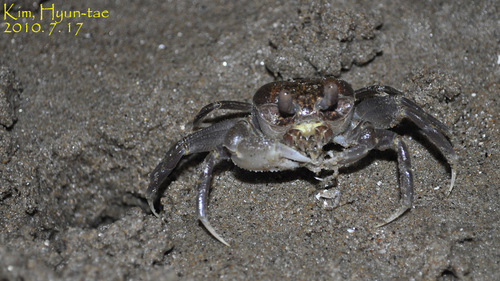
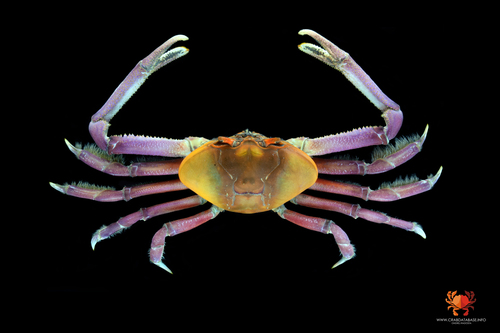
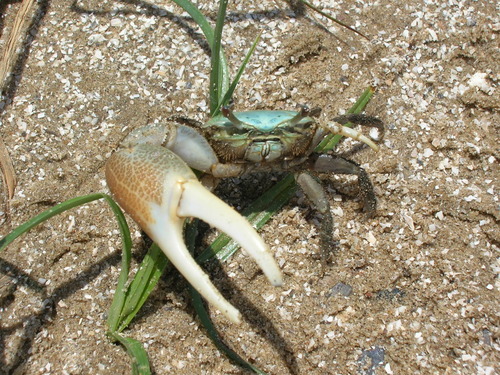
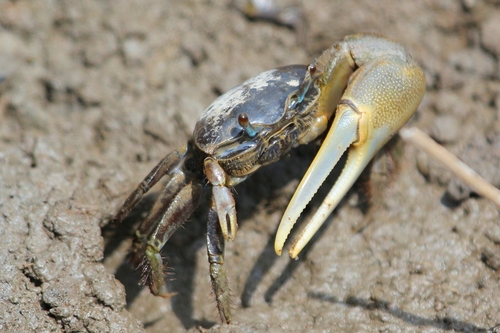
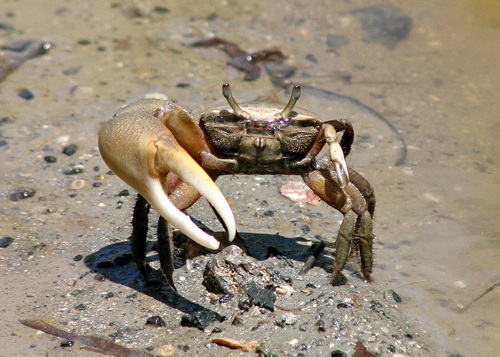
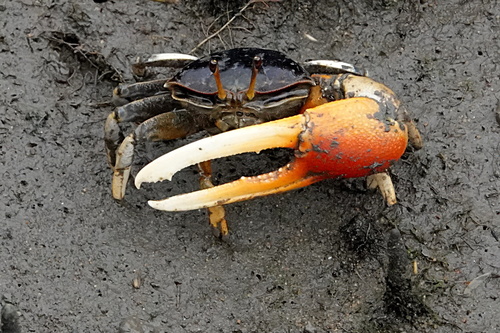
Tubuca coarctata is a species of fiddler crab first described by H. Milne Edwards in 1852. It is found in the western Pacific Ocean, with confirmed locations including Japan, Taiwan, the Philippines, Indonesia, New Guinea, and the Australian states and territories of Queensland and the Northern Territory. This species is commonly known by two names: the compressed fiddler crab and the orange-clawed fiddler crab; note that the name orange-clawed fiddler crab is also used for the species Gelasimus vomeris. These crabs inhabit tidal mudflats adjacent to mangroves, as well as the muddy banks of tidal creeks and rivers. They are medium-sized fiddler crabs; male individuals have a carapace roughly 21 mm across on average. The larger clawed limb of adult males is generally orange or light brown, with this color extending along the top and bottom claw fingers and fading to white at the finger tips. Australian records note that adult males of this species have a distinct white spot on the back of the last walking leg. Carapace color is variable across the species, but adult males typically have a mostly black carapace back marked with white, yellow, or blue patches. Males have a hook-like projection at the tip of their upper claw. This species can be distinguished from the closely related Tubuca dussiemeri, which also has red-orange claw coloration in adult males, by the number of grooves on the claw: Tubuca coarctata has one groove, while Tubuca dussiemeri has two. The carapace of adult females is also typically black, marked with small yellow or blue spots, and occasionally orange markings. Juvenile males have a blue carapace with black markings. Juvenile females have either an orange or blue carapace with black markings similar to those seen on juvenile males. This species was formerly classified as a member of the genus Uca. In 2016, it was moved to the genus Tubuca, which was previously recognized only as a subgenus of Uca.