About Tubastraea coccinea Lesson, 1830
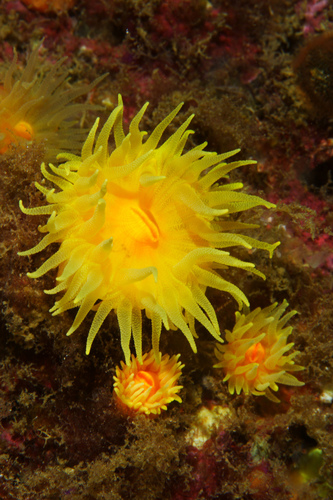
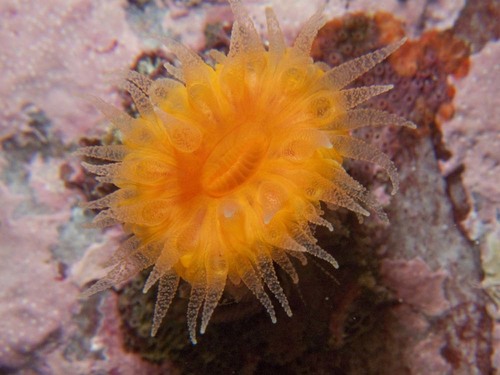
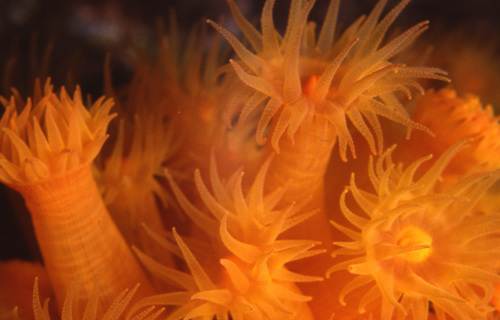
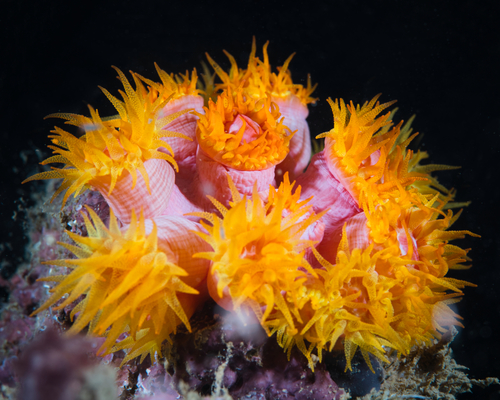
Tubastraea coccinea Lesson, 1830, commonly called orange cup coral, is an azooxanthellate and ahermatypic coral. Its colonies are made of clumps of calcareous cups connected to a spongy calcareous base. Each individual polyp is surrounded by a calcareous wall called a corallite, which can grow to over 11 mm in diameter. The white corallite skeleton has faint ribs, and is divided by 48 septa that extend into the organism’s body cavity, arranged in a cyclic pattern around the center of the corallite. A prominent skeletal projection called a columella sits at the center of the corallite. As its scientific name suggests, T. coccinea has red polyps with yellow-orange tentacles. Colony structure of T. coccinea varies dramatically, and environment appears to play a major role in this variation. Corallites may be directly attached to one another via fused walls (a ceroid arrangement), have separate walls divided by coenosteum (a plocoid arrangement), or be separated by open space (a phaceloid arrangement). Colonies in wave-exposed, aggressive shallow waters tend to be ceroid or plocoid, while those in deeper, calmer waters have a much looser arrangement. This coral can survive without symbiotic photosynthetic algae, so it is able to live in low-light conditions. It occupies shaded vertical surfaces, caves, and caverns down to very large depths, and is also found in very cold water across the globe. In its native Indo-Pacific range, it lives on shaded vertical rock faces, in caves, and under overhangs in shallow water. Its ability to grow in complete darkness allows it to occupy niches that are not favorable to photosynthetic organisms. Orange cup corals often dominate tropical habitats not occupied by other coral species, including wrecks and cryptic reef habitats, and they readily colonize artificial structures. They have been recorded growing on oil and gas rigs, shipwrecks, and other man-made habitats along the Atlantic coast of Florida and the Gulf of Mexico, and experiments show the species has similar preferences for granite, cement, steel and tile substrates. In Brazil, T. coccinea is most abundant in the shallow subtidal zone, at depths between 0 and 3 m (9.8 ft). Man-made structures act as convenient attachment surfaces that facilitate dispersal, enabling secondary colonization of new areas. Outside its native range, T. coccinea is an invasive species in the Gulf of Mexico, the Atlantic coast of Florida, the Caribbean, Brazil, the Atlantic, Brazilian Exclusive Economic Zone, New Zealand Exclusive Economic Zone, the West African region, and the Mediterranean Sea (Malta). Its successful establishment on artificial substrates such as wrecks and oil rigs is well documented, and it has the potential to disrupt native ecosystems. Its ability to colonize a wide diversity of substrates and environments, combined with its reproductive strategies, explains its success in invading a broad range of habitats and its potential impact on marine biodiversity. Though T. coccinea is listed in the Convention on International Trade in Endangered Species (CITES) website and database, it often competes with other benthic invertebrates for substrate space. This competition can put native species at risk, particularly native sponges and corals. Local exclusion or extinction of these native species may occur; loss of native corals can reduce the productivity of the entire ecosystem and compromise ecosystem functions. In 2013, the research organization Marinelife Alliance recorded T. coccinea at Sonadia Island, Cox's Bazar, Bangladesh within its native Indo-Pacific range. A number of biological and ecological traits help T. coccinea invade new areas. It can reproduce both sexually and asexually, which allows it to quickly colonize new habitats. It also grows and regenerates rapidly, so it can heal efficiently from physical damage. The species has high fecundity and produces planula larvae that use ocean currents for dispersal. These larvae can survive for days to weeks before settling on a new surface, allowing offspring to spread over much larger areas. Its ability to colonize a wide range of depths and habitats, including low light and murky waters, lets it occupy and dominate areas that may lack established native organisms. T. coccinea invasions severely disrupt local ecosystems and native organisms because it regularly outcompetes and outgrows native species. Its domination of native environments changes the composition of reef communities and often leads to decreased biodiversity. Its dominance reduces reef structural complexity, homogenizes habitats, and forms monocultures on hard substrates. T. coccinea can reproduce both sexually and asexually, a trait that helps it invade and adapt to new environments. Each individual polyp holds both male and female gonads. During sexual reproduction, the coral releases sperm into the water column, while eggs are retained within the polyp’s gastrovascular cavity. Fertilization therefore occurs internally, producing planula larvae. These free-swimming planktonic larvae can survive for up to 14 days, allowing them to disperse long distances before settling on a suitable substrate and developing into new polyps. Asexual reproduction occurs via budding, where new polyps grow from the oral or basal disc of an existing mature polyp. Budding enables rapid colony growth and successful colonization of new areas. The full life cycle begins with sperm release and internal fertilization of eggs to form planula larvae. After a planktonic stage, the larvae attach to substrates and grow into polyps with calcareous skeletons. These polyps then reproduce sexually or asexually; asexual budding forms new clonal colonies. This combination of sexual and asexual reproduction, plus the long-distance dispersal potential of its larvae, has allowed T. coccinea to spread beyond its native Indo-Pacific range and colonize new areas including the Gulf of Mexico.