About Tubaria punicea (A.H.Sm. & Hesler) Ammirati, Matheny & P.-A.Moreau
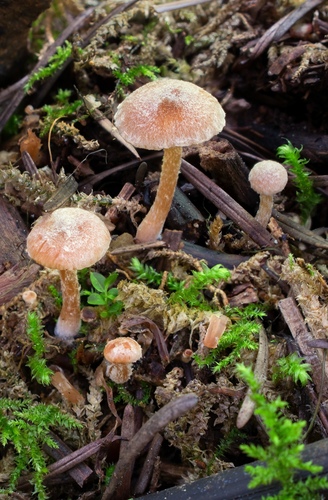
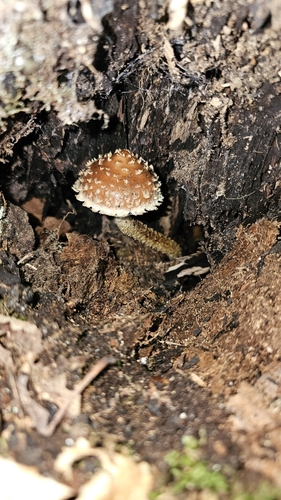
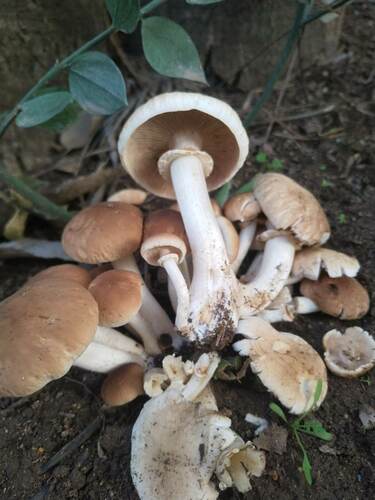
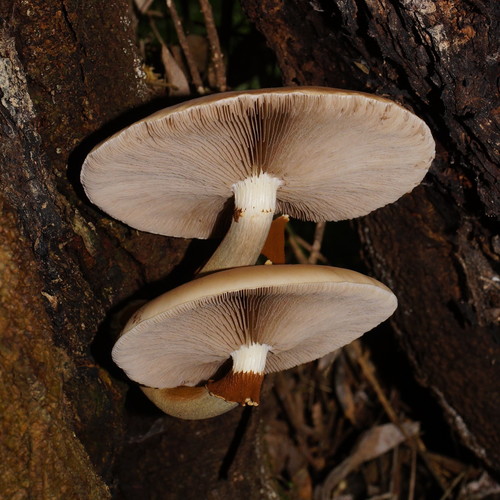
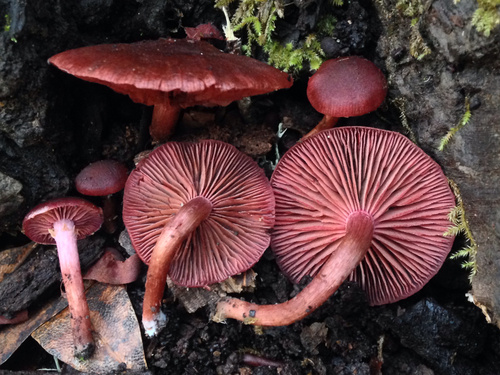
Tubaria punicea fruit bodies have caps that start hemispherical to convex, flattening as they mature, and sometimes develop a low, broad umbo. Cap diameter ranges from 1–5 cm (0.4–2.0 in). The cap surface is dry, colored vinaceous with lighter margins. The cap margin curves downward, bears faint radial grooves, and may become irregular when multiple fruit bodies grow clustered together. The gills attach to the stipe in an adnate to somewhat decurrent arrangement, and are somewhat closely spaced. Gills are initially deep vinaceous, turning brownish with a reddish tinge after spores mature. The stipe is 2–9 cm (0.8–3.5 in) long and 2.6–6 mm (0.1–0.2 in) thick, maintaining consistent width along its length or becoming slightly thicker at the base. It has a fibrillose surface texture, and mature specimens have faint longitudinal grooves. The stipe is wine-red with a whitish base. Young specimens have a silky white partial veil, which becomes fibrillose (resembling a mass of threadlike fibers) and vinaceous as it ages. The flesh is reddish brown and has no detectable odor. The spore print of Tubaria punicea is cinnamon brown. Because the species is rare, its edibility has not been definitively confirmed, but one existing report notes it is "harmless" with a flavor described as "bland beef". Spores typically measure 7.2–7.8 by 4.6–5.1 μm, and range in shape from somewhat bean-shaped (phaseoliform) to elliptical to egg-shaped. The spore-bearing basidia are narrowly club-shaped to somewhat cylindrical, produce 1, 2, or 4 spores each, and measure 26–30 by 5–9 μm. A small number of cystidia are scattered through the hymenium, and these measure 20–33 by 3–5 μm. Cheilocystidia on the gill edge are arranged in clusters; they are club-shaped to egg-shaped, and measure 30–65 by 4–12 μm. The cap cuticle is formed from hyphae arranged in a cutis, where hyphae run parallel to the cap surface, and these hyphae are 4–10 μm in diameter. Clamp connections are present in the hyphae. Tubaria punicea is a saprobic species that grows on rotting Arbutus wood, and fruit bodies are often found in the hollowed bases of large trees. Its typical habitats are mixed forests containing Pseudotsuga, Arbutus, or Quercus. A rare species, it is distributed along the west coast of North America, ranging from British Columbia, Canada to Marin County, California.