About Tubaphe levii Causey, 1954
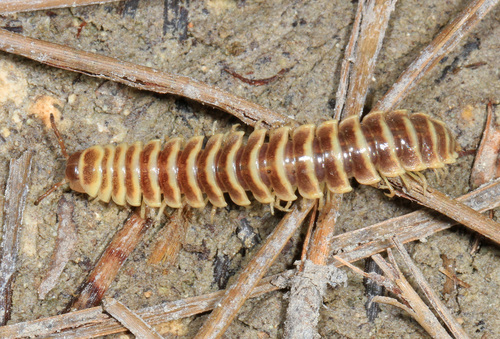
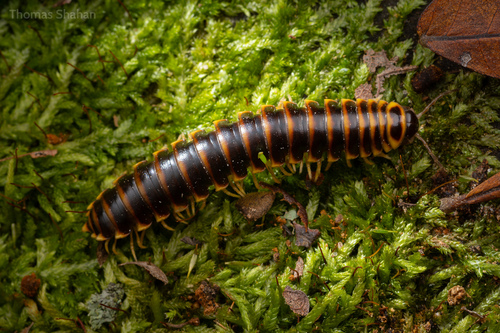
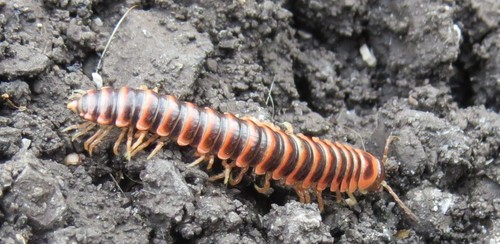
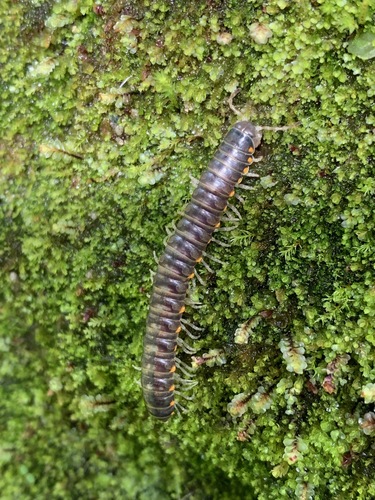
Tubaphe is a genus of millipede in the family Xystodesmidae that contains only one described species, Tubaphe levii. This genus was first established by Nell B. Causey in 1954. When described, Tubaphe was noted to have a simple gonopod with a two-pronged telopodite, and lacks paranota on segments six, eight, eleven, and fourteen. Shelley recorded that T. levii has a nearly cylindrical body, and often completely or nearly lacks paranota on all segments after the first four. Tubaphe levii was first described by N. B. Causey from specimens collected by Dr Herbert W. Levi and Lorna R. Levi at Graves Creek Campground on the Olympic Peninsula. The species was placed in its own unique genus largely due to the reduced paranota found on all segments after the fourth. This characteristic sets T. levii apart from all other American Xystodesmids. The species occurs in the northern areas of the Olympic Peninsula (the location where it was first described) as well as in the southern parts of Vancouver Island, British Columbia. The population on Vancouver Island was first described as Metaxycheir pacifica by Rowland M. Shelley in 1990, and later synonymized with T. levii by Dr. Shelley in 1993.