About Tsuga mertensiana (Bong.) Carrière
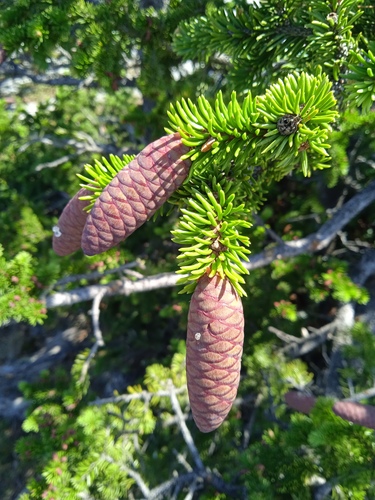
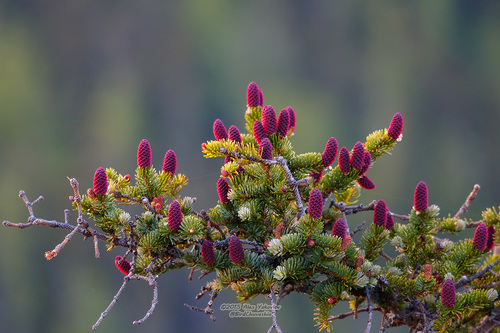
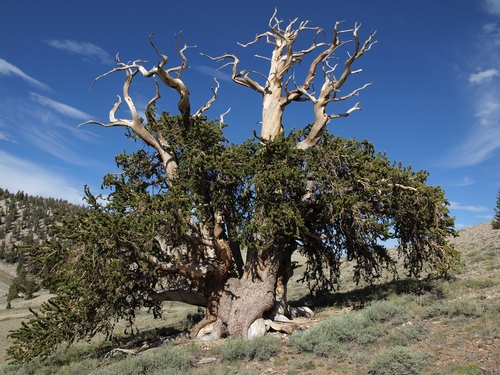
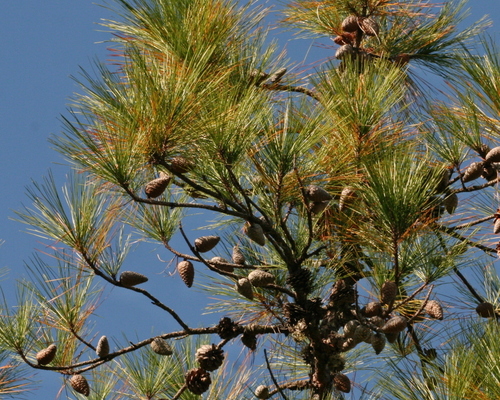
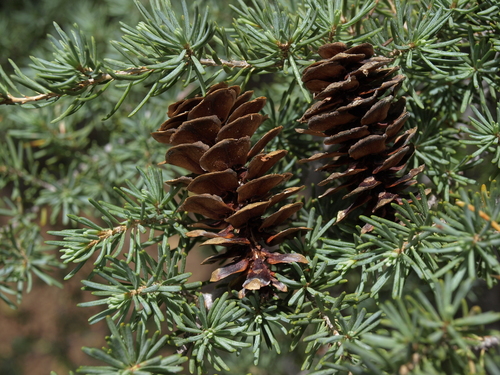
Tsuga mertensiana, also called mountain hemlock, is a large evergreen conifer. It typically reaches 20 to 40 meters (66 to 131 feet) tall, with exceptional specimens growing as tall as 59 meters (194 feet). Its trunk can reach up to 2 meters (6 1/2 feet) in diameter. The bark is 3 centimeters (1 1/4 inches) thick, square-cracked or furrowed, and ranges from purplish-brown to gray in color. Young trees have a neat, slender conical crown with a tilted or drooping lead shoot, while older trees develop a cylindrical crown. All age classes are distinguished by slightly pendulous branchlet tips. Shoots are orange-brown, with dense pubescence about 1 millimeter (1/16 inch) long. Leaves are needle-like, 7 to 25 mm (1/4 to 1 inch) long and 1 to 1.5 mm (1/32 to 1/16 inch) broad. They are soft, blunt-tipped, and only slightly flattened in cross-section; the upper surface is pale glaucous blue-green, and the lower surface has two broad bands of bluish-white stomata with only a narrow green midrib between the bands. Unlike leaves of any other hemlock species, these leaves also have stomata on the upper surface, and they are arranged spirally all around the shoot. Cones are small, but much longer than those of any other hemlock species. They are pendulous and cylindrical, 3 to 8 cm (1 to 3 inches) long and 8 to 10 mm (5/16 to 3/8 inch) broad when closed, opening to 12 to 35 mm (1/2 to 1 3/8 inches) broad, and look superficially similar to small spruce cones. Cones have thin, flexible scales 8 to 18 mm (5/16 to 11/16 inch) long. Immature cones are dark purple, rarely green, and mature to red-brown 5 to 7 months after pollination. Seeds are red-brown, 2 to 3 mm (1/16 to 1/8 inch) long, with a slender pale pink-brown wing 7 to 12 mm (1/4 to 1/2 inch) long. The distribution of Tsuga mertensiana stretches from the Kenai Peninsula, Alaska, to northern Tulare County, California. Its range matches fairly closely that of Tsuga heterophylla (western hemlock), and most populations are found less than 100 kilometers (62 miles) from the Pacific Ocean. There is an inland population in the Rocky Mountains of southeast British Columbia, northern Idaho, and western Montana. These inland populations were most likely established after deglaciation via long-distance dispersal of more than 200 km (120 miles) from coastal populations. In California, the ranges of mountain hemlock and western hemlock differ: western hemlock is restricted to the Coast Ranges, while mountain hemlock is found in the Klamath Mountains and Sierra Nevada. Unlike western hemlock, mountain hemlock mostly grows at high altitudes except in the far north. Its elevation range is from sea level to 1,000 m (3,300 ft) in Alaska, 1,600 to 2,300 m (5,200 to 7,500 ft) in the Oregon Cascades, and 2,500 to 3,050 m (8,200 to 10,010 ft) in the Sierra Nevada. Mountain hemlock typically grows on cold, snowy subalpine sites and grows slowly; some individuals reach over 800 years of age. Arborescent individuals retain narrowly conical crowns until 300 to 400 years old, while shrubby krummholz forms on cold, windy sites near timberline; both forms add beauty to mountain landscapes. Areas occupied by mountain hemlock generally have a cool to cold maritime climate, with mild to cold winters, a short warm-to-cool growing season, and moderate to high precipitation. Mountain hemlock develops best on loose, coarse-textured, well-drained soils with adequate moisture; in British Columbia, it also grows well on thick, very acidic organic matter and decayed wood. Adequate soil moisture is especially important in California and Montana, where summer drought is most pronounced. Mountain hemlock will grow on most landforms, but individuals typically develop best in mixed forest stands on sheltered slopes or in draws. From southern British Columbia southward, the tree grows better on northerly exposures. Its preference for relatively moist, cool sites becomes a necessity at the extremes of its range: in more continental climate of western Montana and in the more mediterranean climate of the central Sierra Nevada. In these locations, mountain hemlock typically grows in isolated populations in north-facing glens and cirque basins where snow collects and may remain well into summer. Mountain hemlock is adapted to sites with long-lasting snowpacks. In spring, mountain hemlocks emerging through 2 to 4 m (6 1/2 to 13 feet) of snow already transpire, while nearby whitebark pines do not start transpiring until the soil beneath them is free of snow. It is also well adapted to handle heavy snow and ice loads, with tough branches and drooping branchlets that shed snow readily. Mountain hemlock is tolerant of shade and other forms of competition. It is more shade-tolerant than all of its associated species except Pacific silver fir, western hemlock, and Alaska cedar. It is considered a minor climax species across most of its habitats, and acts as a pioneer species on glacial moraines in British Columbia and Alaska. In many mountain hemlock forest communities in British Columbia, Washington, and northern Oregon, Pacific silver fir is a major climax species. Alaska cedar, western redcedar, and western hemlock are climax associates on some sites. Mountain hemlock is more commonly the major climax species in the mountain hemlock zone south of central Oregon, where Pacific silver fir does not occur. Mountain hemlock often succeeds lodgepole pine or subalpine fir when these species pioneer on drier sites. It also tends to replace Engelmann spruce when the two species grow together, possibly because hemlock is better able to withstand the allelopathic effects of spruce than other associated species. This species is attacked by the root rot Phellinus weirii. After stands are lost to fire, the area can be populated by lodgepole pine, which is then succeeded by mountain hemlock. Native Americans used this species less often than western hemlock, but specifically used mountain hemlock boughs for beds and bathing brushes. Since the mid-20th century, the species has been used for lumber, often mixed with western hemlock. Outside of its native range, mountain hemlock is grown as an ornamental tree. It is planted as a specimen tree in native plant landscapes in California, and is particularly popular in gardens in northern Great Britain and Scandinavia, where it is valued for its blue-green color and tolerance of severe weather. Cultivation is limited by the very slow growth of young plants and its susceptibility to urban air pollution. Several cultivars have been selected, mainly for intensely glaucous foliage color, including 'Blue Star' and 'Glauca'.