About Tsuga heterophylla (Raf.) Sarg.
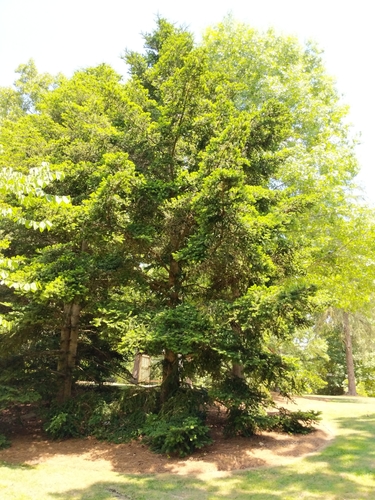
Western hemlock, with the scientific name Tsuga heterophylla (Raf.) Sarg., is a large evergreen conifer. It typically grows 50–70 metres (160–230 feet) tall, and may reach an exceptional maximum height of 83 m (272 ft), with a trunk diameter of up to 2.7 m (9 ft). It is the largest hemlock species; the next largest, mountain hemlock (T. mertensiana), reaches a maximum height of 59 m (194 ft).
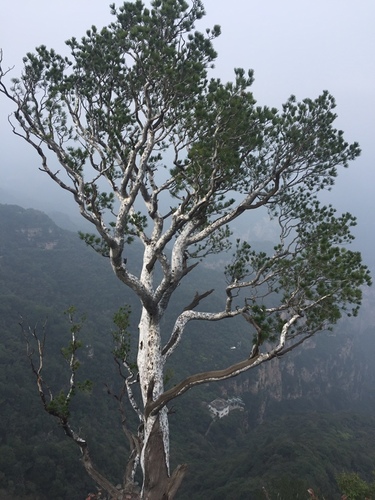
Western hemlock has thin, brown, furrowed bark that outwardly resembles the bark of Douglas-fir. Young trees have a very neat, broad conical crown with a strongly drooping leading shoot; older trees develop a cylindrical crown, and may have no branches on their lowest 30–40 m (100–130 ft). Individuals of all ages are easily recognized by their pendulous branchlet tips. Shoots are very pale buff-brown, almost white, with fine pale hairs around 1 millimetre (1⁄32 in) long.
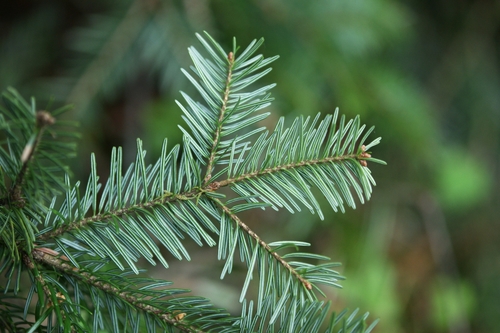
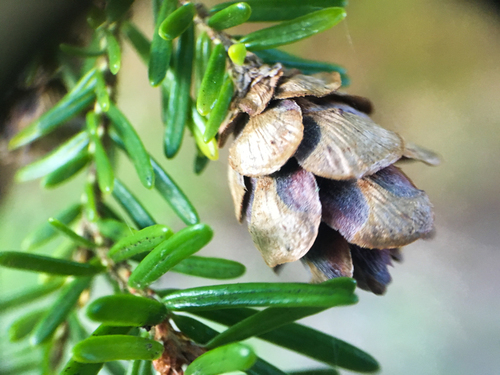
The leaves are needle-like, 5–25 mm (3⁄16–1 in) long and 1.5–2 mm (1⁄16–3⁄32 in) broad, strongly flattened in cross-section, with finely serrated margins and a bluntly acute apex. The upper leaf surface is mid to dark green, while the underside has two distinct white bands of stomata separated only by a narrow green midrib. Leaves are arranged spirally on shoots, but are twisted at the base to lie in two ranks on either side of the shoot.
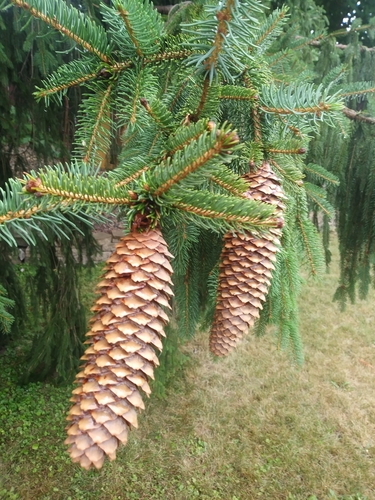
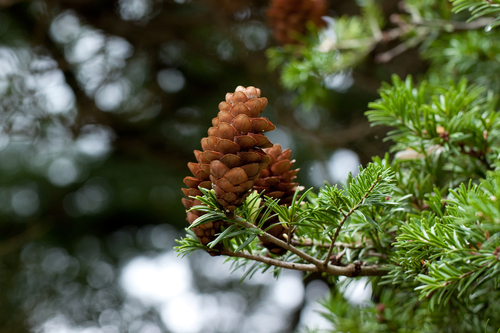
Cones form on trees older than roughly 25 years; they are small, pendulous, and slenderly cylindrical, measuring 14–30 mm (1⁄2–1+1⁄8 in) long and 7–8 mm (1⁄4–5⁄16 in) broad when closed, opening to 18–25 mm (3⁄4–1 in) broad. Cones have 15–25 thin, flexible scales 7–13 mm (1⁄4–1⁄2 in) long. Immature cones are green, and mature to gray-brown 5–7 months after pollination. Cones are usually produced in such large quantities that they cover the ground beneath the tree. Abundant seeds are brown, 2–3 mm (1⁄16–1⁄8 in) long, with a slender pale-brown wing 7–9 mm (1⁄4–3⁄8 in) long.
Initial growth of western hemlock is slow; one-year-old seedlings are commonly only 3–5 centimetres (1+1⁄8–2 in) tall, and two-year-old seedlings 10–20 cm (4–8 in) tall. Once established, saplings growing in full light may have an average annual growth rate of 50–120 cm (20–47 in), rarely reaching 140 cm (55 in), until they reach 20–30 m (65–100 ft) tall. Even when they reach 40–50 m (130–165 ft) tall, individuals growing in good conditions still grow 30–40 cm (12–16 in) annually. The tallest confirmed specimen, at 82.83 m (271 ft 9 in), grows in Prairie Creek Redwoods State Park, California. The species is long-lived, particularly at higher elevations, with confirmed individuals over 1,200 years old.
Tsuga heterophylla is native to the northwest coast of North America. Its range extends north to the Kenai Peninsula, Alaska, and south to northern Sonoma County, California. It is an integral part of Pacific Northwest forests west of the Coast Ranges, where it acts as a climax species, and it is an important timber tree in the region alongside many other large conifer associates. It is closely associated with temperate rainforests, and most of its range lies within 100 kilometres (62 miles) of the Pacific Ocean. Valleys where it occurs generally receive at least 80 cm (31 in) of rain annually. It mostly grows at low altitudes, from sea level to 600 m (2,000 ft), and can be found up to 1,070 m (3,510 ft) in western Washington. It also occurs in humid areas of inland mountains, where western white pine is normally dominant. For example, in the Columbia Mountains spanning southeastern British Columbia and northern Idaho, it grows up to 1,500 m (4,900 ft), particularly on north-facing slopes. In the interior part of its range in Idaho, it can be found up to 1,800 m (5,900 ft). It has naturalized in some parts of Great Britain and New Zealand, where it is considered an introduced rather than an invasive species.
Western hemlock is very shade-tolerant; among its associated species in the Pacific Northwest, only Pacific yew and Pacific silver fir match or exceed its shade tolerance. Young plants typically grow under the canopy of other conifers such as Sitka spruce or Douglas-fir, where they can persist for decades waiting for a gap in the canopy to open. They eventually replace these relatively shade-intolerant conifers in climax forest. Storms and wildfires create larger forest openings where the other conifer species can regenerate. Western hemlock's thin bark and shallow roots leave it susceptible to fire. At higher elevations, it grows intermixed with mountain hemlock and appears to take on some of its characteristics, but there is no conclusive evidence of hybridization between the two.
Western hemlock forms ectomycorrhizal associations with some well-known edible fungi, including chanterelles (Cantharellus formosus, C. subalbidus, and Craterellus tubaeformis). It can associate with both wood-decay fungi and soil fungi, which allows its seedlings to survive growing on rotting stumps and logs. Older forests are damaged by rot-causing fungi, dwarf mistletoe, and leaf-eating insects such as Acleris gloverana and Lambdina fiscellaria.
Western hemlock is cultivated as an ornamental tree for gardens within its native range and along the U.S. Pacific Coast, where it grows most reliably in wetter regions. In relatively dry areas such as Victoria, British Columbia, it has specific requirements for soil conditions. It needs a high level of organic matter, ideally well-rotted wood from an old log or stump, since animal manures tend to have too much nitrogen and salt, and grows best in moist, acidic soil. It is also cultivated in temperate regions worldwide, and has gained the Royal Horticultural Society's Award of Garden Merit. It can be found growing in large gardens in northwest Europe and southern New Zealand.
The species' edible cambium can be collected by scraping slabs of removed bark. The resulting shavings can be eaten immediately, or dried and pressed into bread, a practice historically done by native peoples of Southeast Alaska. Some Native American tribes used the inner bark as an emergency food, and cooked the bark to make medicinal extracts to treat tuberculosis, rheumatic fever, and hemorrhage. Bark can also be boiled to produce a dark red dye, used to make fishing nets and lines less visible to fish.
In southeast Alaska, western hemlock boughs are traditionally submerged during the spring herring spawn to collect herring eggs. The boughs provide an easily collected surface for eggs to attach to, and also add a distinctive taste. This practice originates from traditional gathering methods of Tlingit people of southeast Alaska. Tender new-growth needles can be chewed directly or made into a tea with a clean, forest-like aroma, and the tea is rich in vitamin C, similar to some other hemlock and pine species. This use is traditional among peoples of the Northwest Coast.
The bark has long been used as a source of tannin for tanning leather. Planted along river banks, western hemlock helps reduce erosion. Outside its natural range, it is an important forestry species. Until the early 1920s, the tree was largely ignored for lumber use because it was assumed to be similar to poor-quality eastern hemlock. Since that time, it has been widely used for paper production and as a softwood timber to make doors, joinery, and furniture. Its fiber is also used to make rayon and various plastics.