About Tsuga caroliniana Engelm.
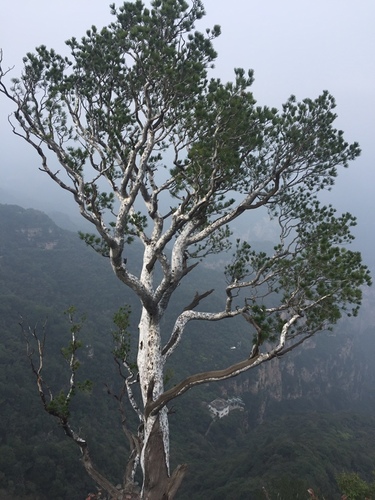
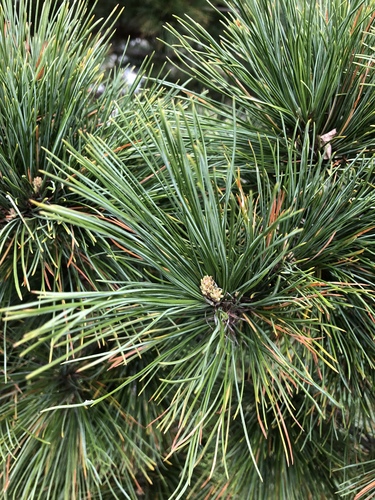
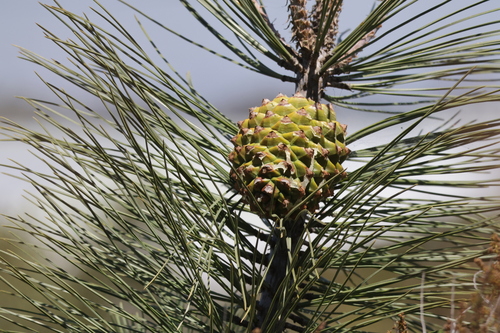
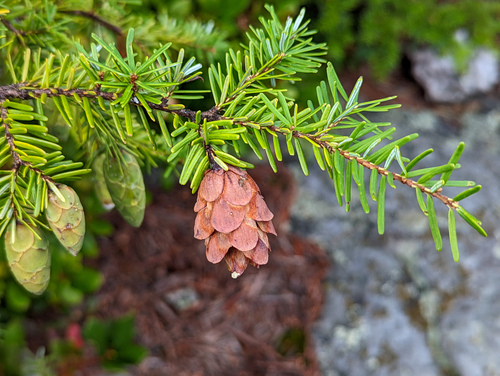
Tsuga caroliniana Engelm., commonly called Carolina hemlock, is an evergreen coniferous tree. In forest conditions, it grows up to 30 m (98 ft) tall, and exceptionally reaches 34 m (112 ft), with a trunk diameter up to 110 cm (43 in). It has a compact, pyramidal crown that can grow up to 8 m (26 ft) wide. The bark is thick, reddish-brown, and develops fissures between scaly ridges as it ages. Its branches are stout, usually horizontal, and often slightly drooping. Shoots are red-brown to orange-brown and covered in fine hairs. The leaves measure 5–20 mm (0.20–0.79 in) long and 1.8–2 mm (0.071–0.079 in) broad; they are flattened, do not taper toward their ends, and have a rounded or slightly notched apex. Leaves radiate outward in all directions from the twigs, and smell of tangerine when crushed. They are glossy dark green on the upper surface, paler on the underside, and marked with two white stomatal bands. The cones are 2–4 cm (0.79–1.57 in) long; they start green and mature to light to mid-brown 6–7 months after pollination. When fully open, the cone scales sit at a right angle to the central axis or are reflexed backward toward the cone base. Carolina hemlock is native to the Appalachian Mountains, found in southwest Virginia, western North Carolina, extreme northeast Georgia, northwest South Carolina, and eastern Tennessee. It grows on rocky mountain slopes at elevations between 700–1,200 m (2,300–3,900 ft). It grows best in partly shady areas with moist, well-drained soil and a cool climate. A small, self-sustaining population of Carolina hemlock grows in the Virginia Kendall State Park Historic District of Cuyahoga Valley National Park in northeast Ohio; this population was originally planted as part of 1930s and 1940s reforestation work during the park's development.