About Trygonoptera testacea Müller & Henle, 1841
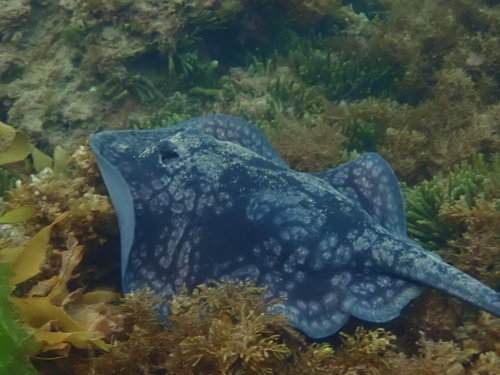
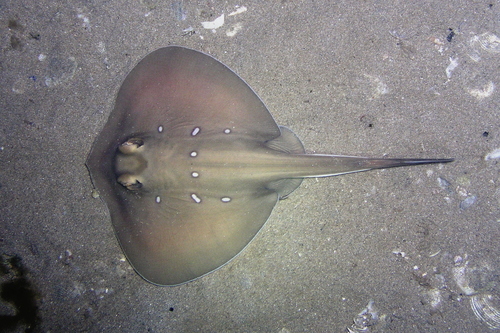
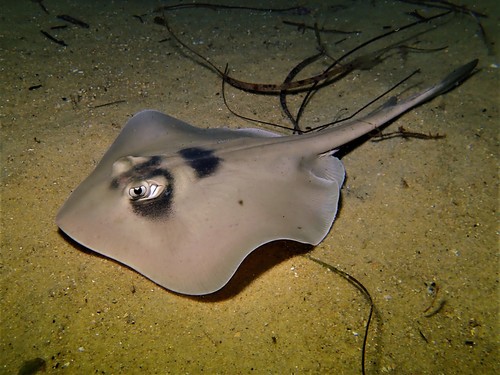
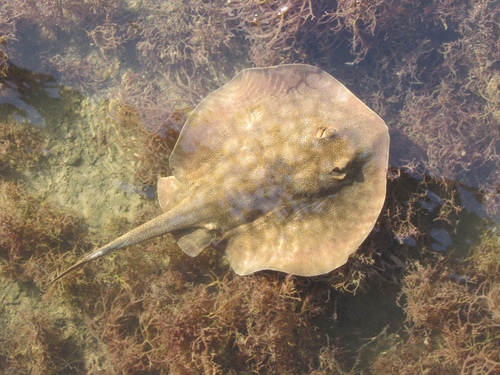
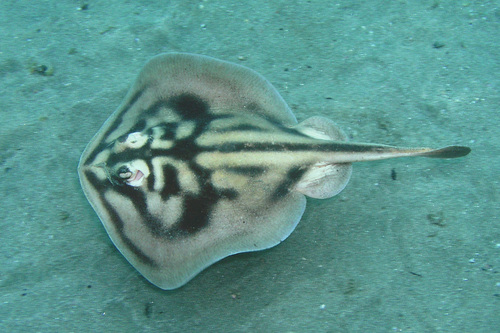
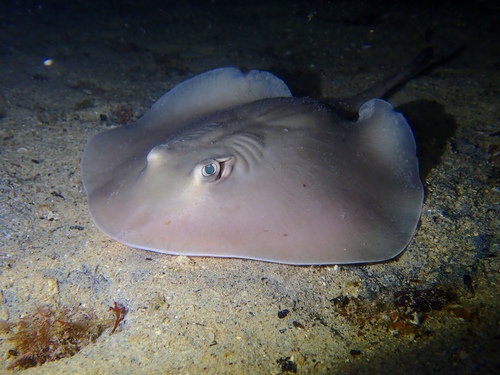
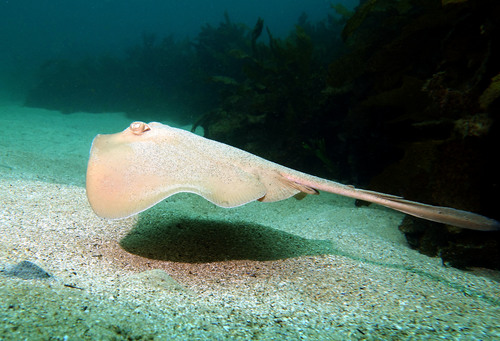
The scientific name of the common stingaree is Trygonoptera testacea Müller & Henle, 1841. This ray has a rounded pectoral fin disc that is slightly wider than it is long. Nearly straight anterior margins of the disc converge at a broad angle on its fleshy snout, and the snout tip may protrude slightly past the disc. Its eyes are medium-sized, and are immediately followed by comma-shaped spiracles with angular posterior margins. The outer rim of each nostril is enlarged into a broad, flattened lobe. A skirt-shaped curtain of skin sits between the nostrils, with a strongly fringed posterior margin that overhangs the small mouth. There is a patch of nipple-shaped papillae on the lower jaw, and 3 to 5 papillae across the floor of the mouth. Its teeth are small with roughly oval bases, and its five pairs of gill slits are short. The pelvic fins are small with rounded margins. The tail is 86 to 90% as long as the disc, has a flattened oval cross-section, and lacks lateral folds. One or two serrated stinging spines are located on top of the tail about halfway along its length. Just before the sting is a small dorsal fin, which may be reduced to a low ridge in a small number of individuals. The end of the tail has an elongated, leaf-shaped caudal fin. The entire skin of the common stingaree is smooth. This species is plain brownish or grayish on its upper surface, lightening toward the edges of its fins, and darkening on the dorsal fin and the trailing margin of the caudal fin (the entire caudal fin is black in juvenile individuals). Its underside is white, and occasionally has wide dusky bands that border the lateral margins of the disc. The common stingaree can grow to 52 cm (20 in) long, and possibly up to 61 cm (24 in); records of larger specimens most likely represent misidentifications of the eastern shovelnose stingaree (T. imitata). The common stingaree is only found in coastal waters off eastern Australia, ranging from Caloundra in southern Queensland to Cape Howe in Victoria; the majority of its population occurs north of Jervis Bay. It is the most abundant inshore ray within this range. This is a bottom-dwelling species that favors sandy flats and rocky reefs, and also travels well upstream into brackish estuaries. It is most often found from the surf zone down to a depth of 60 m (200 ft), though there are records of individuals in offshore, soft-bottomed areas as deep as 135 m (443 ft). The common stingaree occupies a similar ecological niche to the related eastern shovelnose stingaree, which has a more southerly distribution. By volume, polychaete worms make up over three-quarters of this ray's diet. It prefers errant polychaetes, which are relatively mobile and generally found buried shallowly in sediment. Crustaceans are a major secondary food source, particularly shrimp, and also including amphipods, penaeid prawns, crabs, isopods, and stomatopods. Small bony fishes, lancelets, and molluscs are eaten infrequently. Very young rays measuring 10–15 cm (3.9–5.9 in) long feed almost exclusively on shrimp; as individuals age, polychaetes become progressively more important to the diet until they become the dominant food source. Like other stingrays, the common stingaree is aplacental viviparous; females sustain their developing embryos with nutrient-rich histotroph, also called "uterine milk". Typically, two pups are born at a time. Birth probably occurs in early spring, after a gestation period of approximately one year, as seen in related species. Newborn common stingarees measure around 12 cm (4.7 in) long. Males reach sexual maturity at 35 cm (14 in) long, while females reach sexual maturity at 40 cm (16 in) long. Known parasites of the common stingaree include a tapeworm species of the genus Acanthobothrium, a fluke species of the genus Monocotyloides, the monogenean Heterocotyle robusta, and the nematodes Paraleptus australis and Proleptus urolophi.