About Trygonoptera personata Last & Gomon, 1987
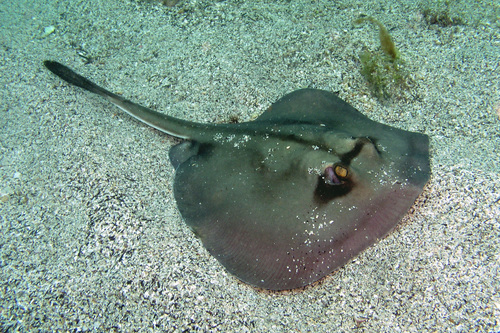
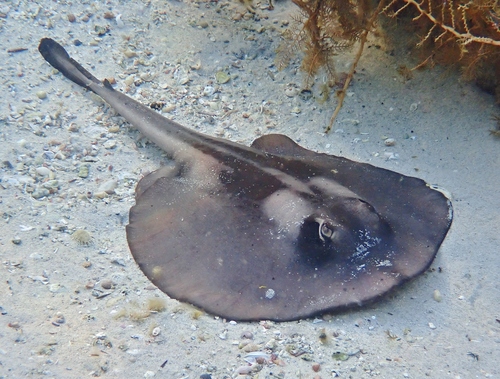
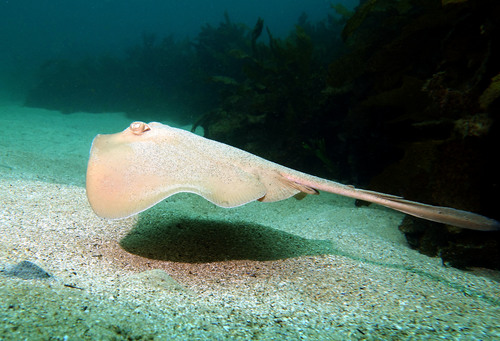
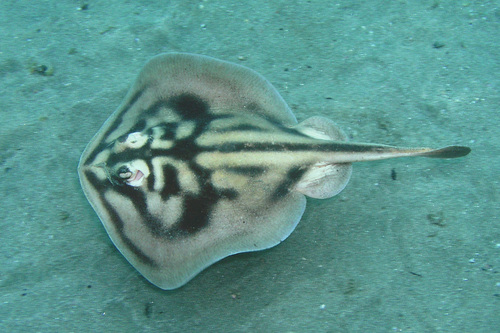
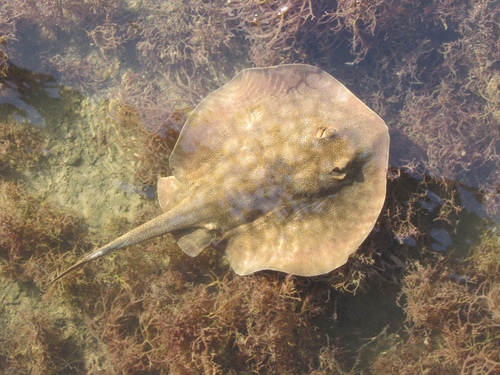
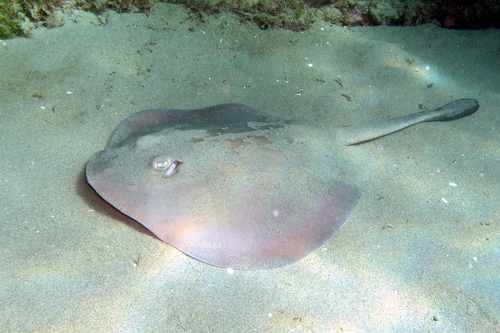
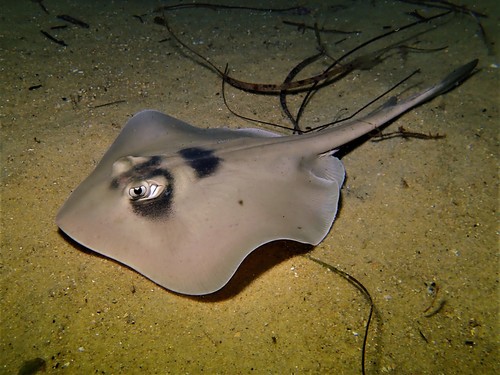
The masked stingaree (Trygonoptera personata Last & Gomon, 1987) has a pectoral fin disc that is roughly as long as it is wide, with a rounded shape. The anterior margins of the disc are nearly straight, converging at an obtuse angle onto a fleshy, non-protruding snout. Its eyes are moderately sized, and are immediately followed by comma-shaped spiracles with angular posterior rims. The outer margin of each nostril is enlarged into a broad, flattened lobe. Between the nostrils sits a skirt-shaped curtain of skin with a fringed trailing edge, which hides the small mouth. The lower jaw has a patch of subtle papillae, which are nipple-shaped structures; there are also 3–4 papillae on the floor of the mouth. The small teeth have roughly oval bases, and the five pairs of gill slits are short. The pelvic fins are small with rounded margins. Its tail is 67–86% as long as the disc, has an oval cross-section, and is slightly flattened at the base. There is a single serrated stinging spine on the upper surface of the tail, which is positioned right after a rather large dorsal fin. The tail ends in an elongated, leaf-shaped caudal fin, and has no lateral fin folds. The skin has no dermal denticles. This ray has an ochre to gray dorsal coloration with two large, distinctive dark blotches: one forms a "mask" around the eyes, and the other sits at the center of the disc. These blotches may be connected by thin lines along the midline and on either side. The underside is white, turning darker toward the fin margins. The dorsal and caudal fins are black in young rays, and fade to gray in adult individuals. Males grow up to 27 cm (11 in) across the disc, while females grow up to 31 cm (12 in) across. The masked stingaree is found off the coast of Western Australia, ranging from Shark Bay to Geographe Bay. It is one of the most abundant members of its family within its range, especially in the southern part of this area. This bottom-dwelling ray occurs from the shore down to 115 m (377 ft) deep on the continental shelf, and is most common in offshore waters 20–35 m (66–115 ft) deep. It prefers sandy flats and seagrass beds. There is no evidence of age or sex segregation, nor of seasonal migrations for this species. Polychaete worms and crustaceans are the main food of the masked stingaree; occasionally it also eats sipunculid worms, molluscs, and echinoderms. This species preys on both sedentary polychaetes, which typically live in deeply buried tubes, and errant polychaetes, which are generally more mobile and buried more shallowly. The expanded lobes and sensory papillae near its mouth likely help it locate and dig out this burrowing prey. Young rays feed mainly on crustaceans, including mysids, amphipods, cumaceans, tanaids, and shrimp. As they age, polychaetes are added to their diet; sedentary polychaetes are important for rays 13–29 cm (5.1–11.4 in) across, while errant polychaetes become progressively more important, to the point that the largest rays eat almost only errant polychaetes. Like other stingrays, the masked stingaree is aplacental viviparous. Females have only one functional uterus, the left one, and produce one pup per year, rarely two. Ovulation and mating take place from mid-June to mid-July; fertilized eggs are enclosed in a delicate brown capsule and kept in a state of diapause, or dormancy, inside the uterus until November. After this period, embryos develop rapidly and are nourished by nutrient-rich histotroph, also called "uterine milk", produced by the mother. On average, an embryo's disc width grows from 1.1 cm (0.43 in) in December to 11 cm (4.3 in) in April, and is born in late April or early May at a disc width of 13 cm (5.1 in). The total gestation period, including diapause, lasts 10–12 months. Females grow more slowly and reach a larger maximum size than males. Males reach sexual maturity at around 22 cm (8.7 in) across the disc, and females at 23 cm (9.1 in) across; both sexes mature at an average of four years of age. The maximum lifespan is 10 years for males and 16 years for females.