About Trygonoptera ovalis Last & Gomon, 1987
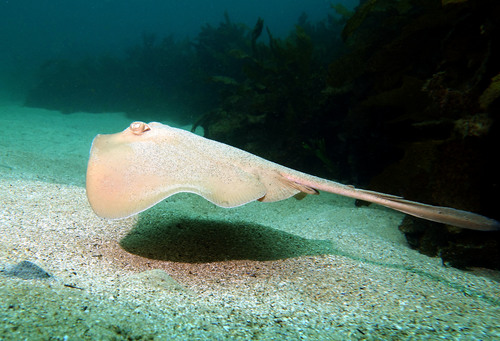
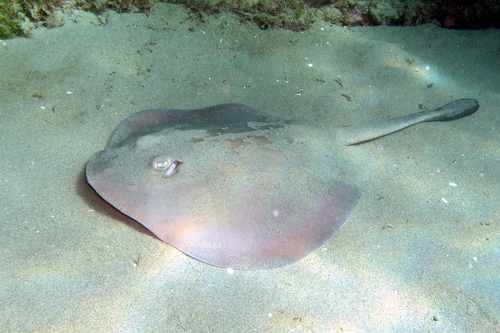
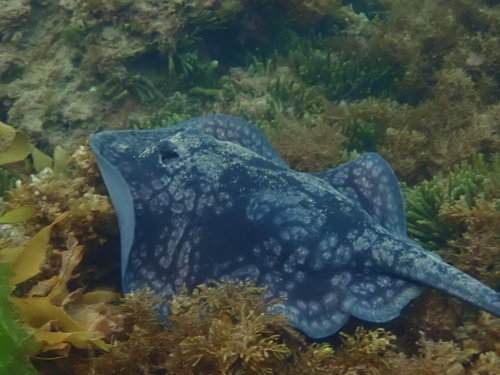
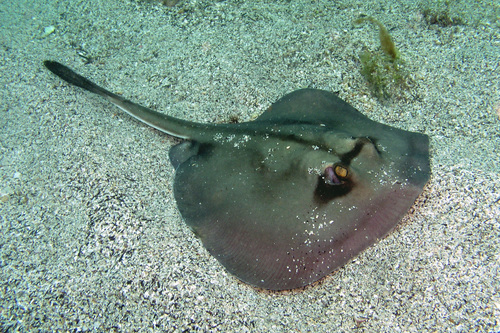
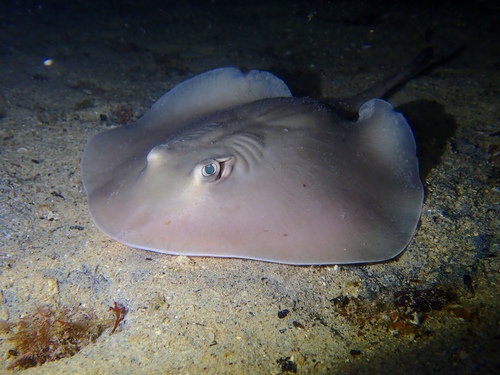
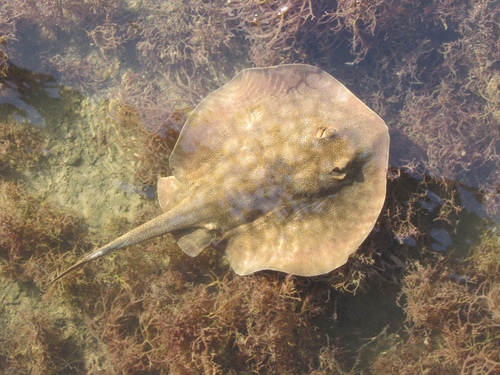
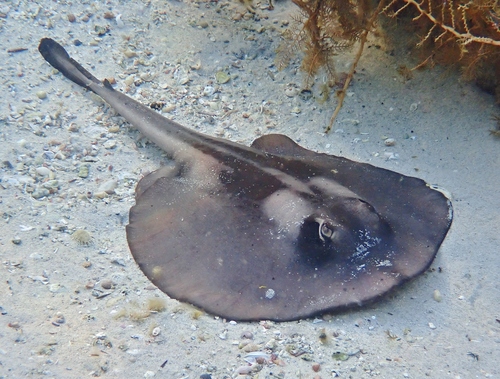
More than any other member of its genus, the pectoral fin disc of the striped stingaree (Trygonoptera ovalis Last & Gomon, 1987) has an oval shape. The disc is slightly longer than it is wide, with anterior margins that converge at an obtuse angle on the rounded, non-protruding tip of the fleshy snout. Medium-sized eyes are immediately followed by comma-shaped spiracles with angular posterior rims. The outer rims of the nostrils are enlarged into prominent lobes. Between the nostrils sits a skirt-shaped curtain of skin with long fringes on its posterior margin, which overhangs the small mouth. Numerous nipple-like papillae are found on the lower jaw, and four tiny papillae are present on the floor of the mouth. The small teeth have roughly oval bases. The five pairs of gill slits are short. The pelvic fins are small and rounded. The tail measures 75–100% as long as the disc, is oval in cross-section, slightly flattened at the base, and ends in a fairly large, deep, leaf-shaped caudal fin. A serrated stinging spine is positioned on the upper surface of the tail, directly preceded by a small dorsal fin; there are no lateral fin folds. The entire skin surface is smooth. This species has a distinctive dorsal color pattern: over a grayish to grayish brown background, there is a dark mask-like pattern around the eyes that may extend to the snout tip, which is most obvious in juveniles. It also has a pair of dark blotches at the center of the disc that are drawn out posteriorly into stripes running onto the tail; the area between the stripes is relatively light. The dark markings may be faint in some individuals. The underside is pale with dark margins on the fins, and the caudal fin is gray or black with a darker trailing margin. The maximum known length of this species is 61 cm (24 in). The striped stingaree is found only along the coast of Western Australia, ranging from Eucla to the Houtman Abrolhos, at depths between 1 and 43 m (3.3–141.1 ft). This common bottom-dwelling ray favors rocky areas and reefs, often in and around seagrass beds, and has also been observed over sand near beaches. The smoothly rounded, flexible margins of the striped stingaree's disc give it superior agility compared to most other rays, allowing it to move unencumbered through structurally complex terrain and vegetation. It often seeks shelter beneath patches of seagrass, but has also been observed resting in the open or buried in sand. Little is known about its natural history. Reproduction is presumed to be aplacental viviparous, like in other stingrays; males reach sexual maturity at around 35 cm (14 in) long.