About Trygonoptera mucosa (Whitley, 1939)
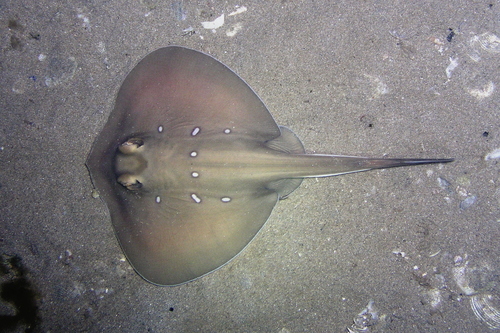
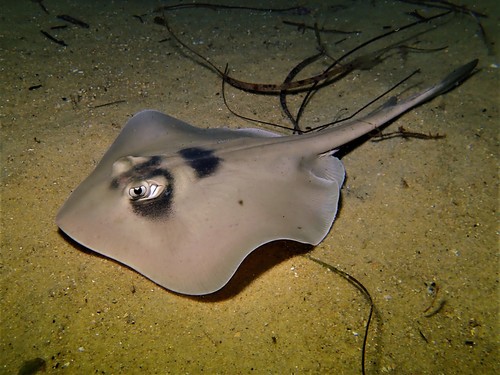
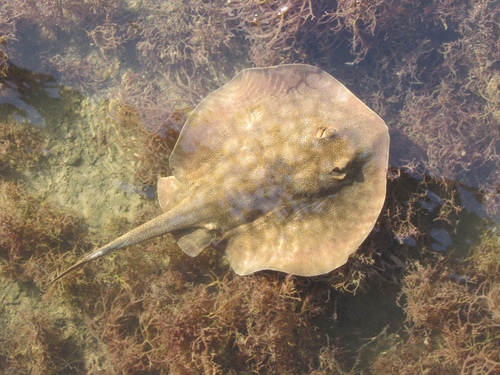
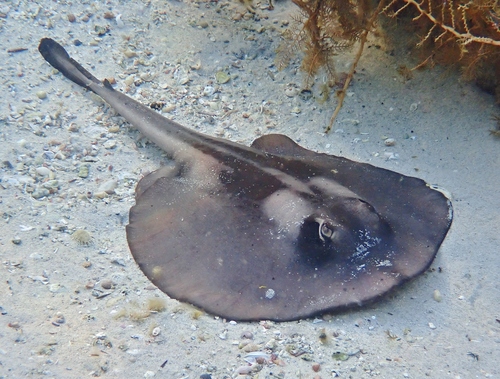
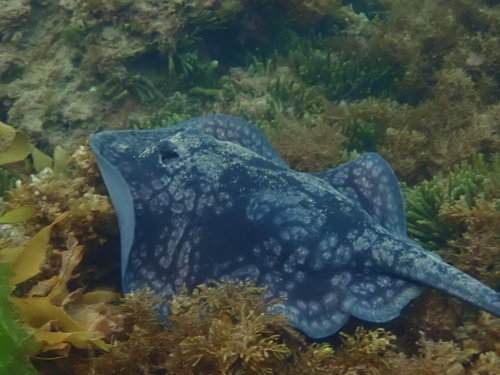
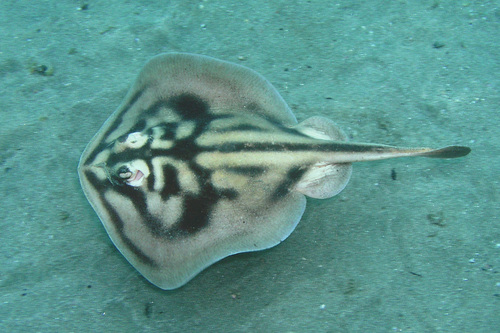
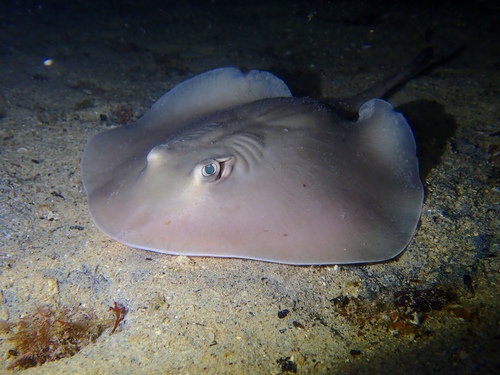
Scientific name: Trygonoptera mucosa (Whitley, 1939). The western shovelnose stingaree has a rounded pectoral fin disc that is slightly wider than it is long. The leading margins of the disc are nearly straight and converge at an obtuse angle on the fleshy snout, which has a blunt, non-protruding tip. Modestly sized eyes are followed by much larger, comma-shaped spiracles, whose "tails" curl down and forward to beneath the anterior third of the eyeball; the posterior margins of the spiracles are angular. The outer rims of the nostrils are expanded into large, flattened lobes. Between the nostrils lies a skirt-shaped curtain of skin with a deeply fringed posterior margin that obscures the small mouth. The lower jaw bears a patch of nipple-shaped papillae structures, and 7–9 small papillae are found across the floor of the mouth. The teeth are small with roughly oval bases, and the five pairs of gill slits are short. The pelvic fins are small and rounded. The tail measures 71–91% of the disc length, has a flattened oval cross-section, and ends in a low leaf-shaped caudal fin. A serrated stinging spine sits on the dorsal surface of the tail about halfway along its length; there are no dorsal fins or lateral fin folds. The skin is completely free of dermal denticles. The dorsal side of the western shovelnose stingaree ranges from grayish to ochre to dark brown, and becomes dusky to black on the caudal fin; some individuals also have an irregular scattering of lighter and darker spots. The underside is white to beige, occasionally with a wide, dark brown band and blotches along the margins of the disc and tail, a pattern that is most obvious in juveniles. This species has a maximum reported disc width of 28 cm (11 in) for males and 37 cm (15 in) for females. The western shovelnose stingaree is endemic to southwestern Australia, where it is one of the most common members of its family. Its range extends from Gulf St Vincent near Glenelg westward to Perth, and possibly extends further north to Dongara. This is a bottom-dwelling species that inhabits sandy and seagrass habitats at a depth of 1–40 m (3.3–131.2 ft), and particularly favors relatively deeper waters close inshore. Individuals of all ages and both sexes occupy the same habitats year-round. The proportionately larger spiracles of the western shovelnose stingaree suggest it is adapted to environments with lower dissolved oxygen levels than its close relatives. This species feeds predominantly on polychaete worms, which make up over 85% of its diet by volume; most of the consumed polychaetes are the sedentary type that typically live in buried tubes. The enlarged lobes and numerous sensory papillae near its mouth likely help locate, reach, and extract this deep-burrowed prey; the ray also has a mechanism to avoid ingesting sediment, possibly by expelling it through the gill slits. Crustaceans including shrimp, amphipods, isopods, mysids, and tanaids, and sipunculid worms are minor secondary food sources. Molluscs, echinoderms, and bony fishes are eaten very rarely. Rays of all ages have similar overall diets, though amphipods and tanaids are generally only eaten by small rays, and sipunculids by large rays. A known parasite of this species is the nematode Echinocephalus overstreeti. Like other stingrays, the western shovelnose stingaree is aplacental viviparous; adult females have a single functional uterus on the left, and produce litters that usually have one, and rarely two, pups every year. Ovulation and mating take place in May or June. Newly fertilized eggs are enclosed by a thin brown membrane, and may go through a short period of diapause, or suspended development, before embryonic growth begins, matching the pattern seen in related species such as T. personata. The total gestation period lasts around a year; once developing embryos use up their yolk supply, they receive nutrient-rich histotroph, also called "uterine milk", from the mother. Parturition occurs in late May or early June. Newly born rays have a disc width of around 11 cm (4.3 in). Females grow more slowly and reach a larger maximum size than males; males reach sexual maturity at a disc width of roughly 22 cm (8.7 in) and two years of age, while females reach sexual maturity at a disc width of 25 cm (9.8 in) and five years of age. The maximum lifespan is 12 years for males and 17 years for females.