About Trygonoptera imitata Yearsley, Last & Gomon, 2008
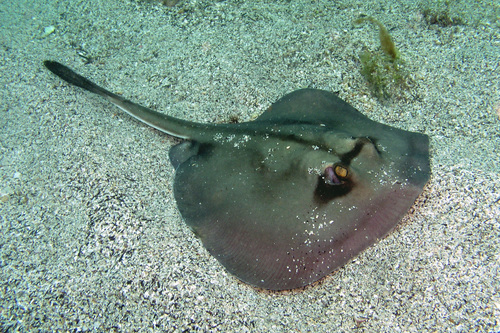
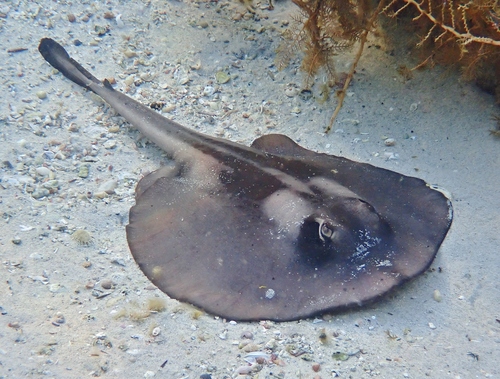
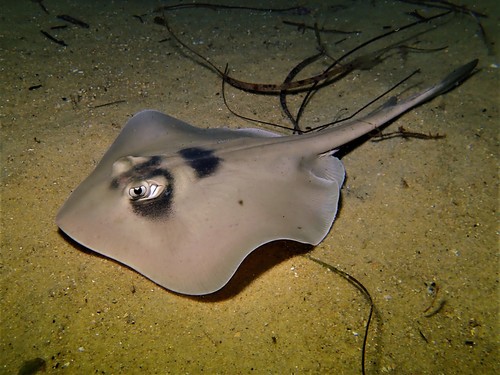
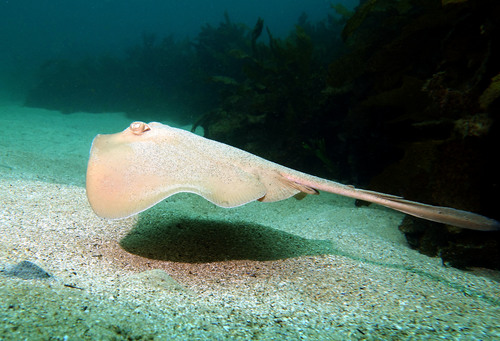
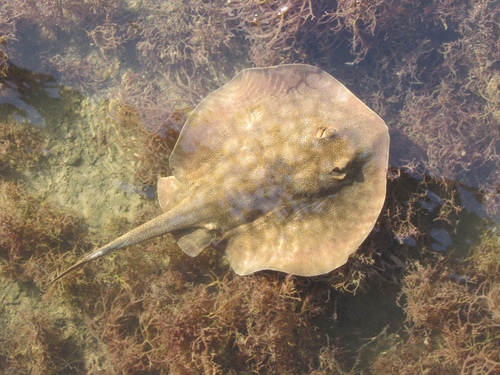
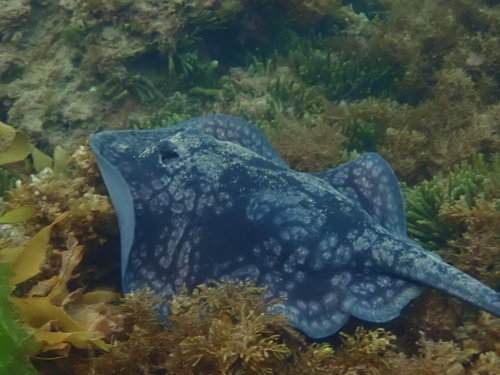
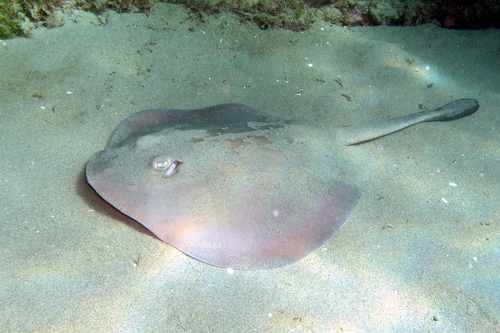
The eastern shovelnose stingaree (Trygonoptera imitata) has a rounded pectoral fin disc that is wider than it is long, and thick at the center. The anterior margins of the disc are straight to gently convex, converging at a blunt angle on the fleshy, non-protruding snout, while the outer corners of the disc are broadly rounded. Its medium-sized eyes are followed by larger comma-shaped spiracles, which have angular posterior rims and "tails" that curve down and forward to below the front third of the eyeball. The outer rim of each nostril is enlarged into a prominent, flattened lobe. Between the nostrils, there is a skirt-shaped curtain of skin with a deep midline furrow lined by nipple-like structures called papillae, and a deeply fringed posterior margin that overhangs the small mouth. The lower jaw conceals the upper jaw and has a dense patch of papillae. The floor of the mouth has three papillae in the middle, and one or two papillae near either corner. Its teeth have blunt, oval bases; teeth towards the interior and middle of the lower jaw become more triangular with serrated edges. The teeth are arranged in a quincunx pattern, with around 22 upper tooth rows and 24 lower tooth rows. It has five pairs of S-shaped gill slits. Its pelvic fins are modestly sized and roughly triangular; males have robust, tapering claspers. The smoothly tapering tail has a flattened oval cross-section at the base, ends in a lance-like caudal fin, and is about three-quarters as long as the disc. Most individuals have two serrated stinging spines on top of the tail, about halfway along its length, with the upper spine generally larger than the lower one. The tail has no dorsal fins or fin folds, and the entire skin is completely smooth. Dorsal coloration ranges from yellowish to dark grayish brown, darkest toward the midline and lightest toward the fin margins; some larger individuals also have a scattering of fine black and beige spots. The underside is light-colored with dark fin margins, and sometimes has irregular dark blotches on the abdomen. The portion of the tail past the base is entirely dark. This species reaches a maximum known length of 80 cm (31 in), making it the largest member of its genus and among the larger members of its family. The eastern shovelnose stingaree is found off southeastern Australia, from Jervis Bay in New South Wales to Beachport, and probably extends to Gulf St Vincent in South Australia. It occurs in the northern Bass Strait and has been recorded off Flinders Island, but is not found in Tasmania itself. The center of its distribution is off Victoria, and it is abundant in Port Phillip and Western Port. As a bottom-dwelling species, it favors sheltered, inshore habitats with soft bottoms in water less than 5 m (16 ft) deep, though it has been found as deep as 120 m (390 ft). There is also a record of a specimen, apparently this species, collected from the continental slope at a depth of 200–440 m (660–1,440 ft). The eastern shovelnose stingaree feeds on small benthic organisms, primarily polychaete worms, and excavates pits when searching for prey. Females have a single functional ovary, located on the right side, and are aplacental viviparous like other stingray species. After fertilization, relatively large eggs are retained in the uterus without developing for 5–8 months. After this dormant period, embryos emerge and develop rapidly to birth over 4–7 months. Embryos are first sustained by internal and external yolk sacs; once the yolk supply is exhausted, the mother provides them with nutrient-rich histotroph, also called "uterine milk". Females produce one litter per year, born between late February and April, and ovulate a new batch of eggs immediately after giving birth. Litter size can reach up to seven, and increases with female body size. Newborns measure 20–25 cm (7.9–9.8 in) long; a newborn weighs 150 g (5.3 oz), which is only a tenfold increase from the weight of the original egg, the smallest such increase recorded for any live-bearing ray. Males reach sexual maturity at about 46 cm (18 in) long and 4.5 years of age, while females reach sexual maturity at about 49 cm (19 in) long and 5 years of age. The maximum lifespan is at least 10 years for males and 12 years for females.