About Tropaeolum tuberosum Ruiz & Pav.
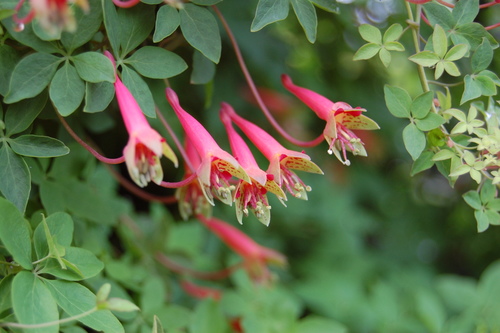
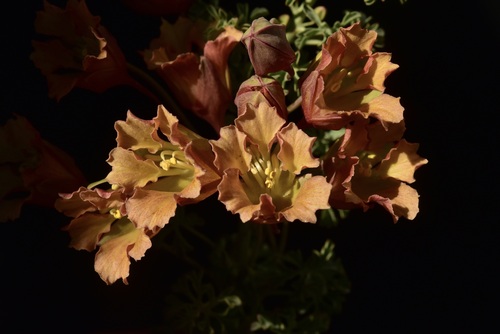
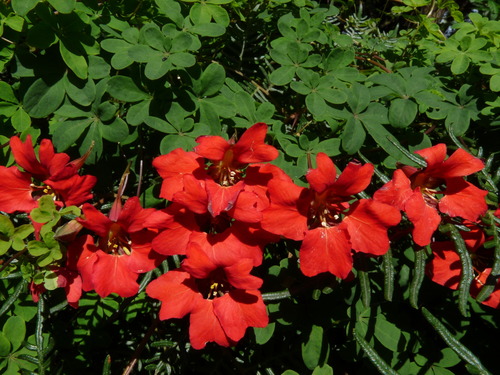
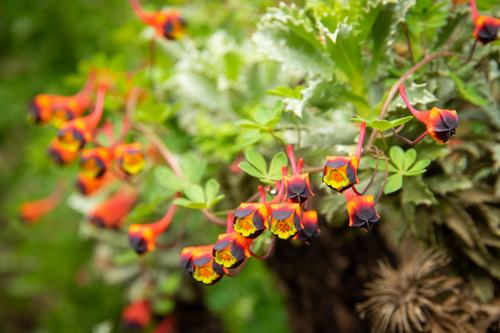
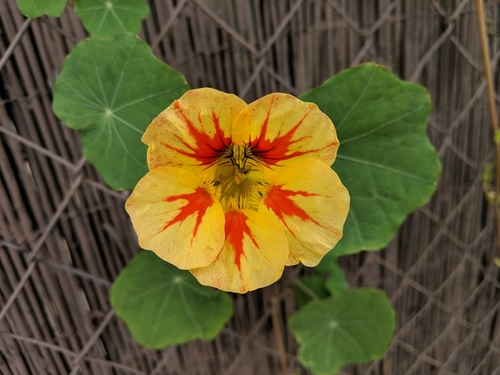
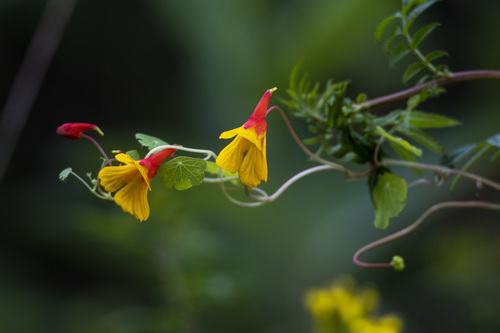
Tropaeolum tuberosum Ruiz & Pav., commonly known as mashua, is a species of flowering plant in the Tropaeolaceae family. It is cultivated in the Andes, primarily in Peru and Bolivia, to a smaller degree in Ecuador, and in parts of Colombia, for its edible tubers, which are eaten cooked or roasted as a vegetable. It serves as a minor food source, especially for native Amerindian populations. Mashua is a herbaceous perennial climbing plant that reaches 2–4 m (7–13 ft) in height. It is related to garden nasturtiums, and is sometimes grown as an ornamental for its brightly colored tubular flowers. Its leaves are peltate, roundly five-lobed, with a weakly twining petiole that is not a true tendril, and it produces a tuberous root. In culinary use, raw mashua tubers are bitter due to glucosinolates, but this bitterness decreases after cooking, freezing, or pounding. By dry weight, tubers make up as much as 75 percent of a mature plant. Wider popularization of mashua may be limited by its strong flavor and its reputation as an anaphrodisiac. In the 16th century, Father Bernabé Cobo recorded that the Inca gave large quantities of mashua to their troops to help them forget their wives. Despite this, mashua tubers roasted in traditional earthen field ovens built at harvest are considered a delicacy. Thinly shredded raw mashua tubers can also be added to salads to add a spicy flavor and crunchy texture. While mashua is mainly cultivated for its edible tubers in its native range, it has ornamental value in temperate zones for its trailing growth habit and showy, bi-colored tubular flowers that bloom in summer and autumn. Its sepals are orange-red, and its petals are bright yellow. In regions that experience frost, the plant requires some winter protection. The cultivar Tropaeolum tuberosum var. lineamaculatum 'Ken Aslet' has received the Royal Horticultural Society's Award of Garden Merit. Mashua is believed to have anaphrodisiac effects. Spanish chronicler Bernabé Cobo recorded that Inca Emperors fed mashua to their armies "that they should forget their wives". Studies on male rats fed mashua tubers found a 45% drop in testosterone levels, caused by the presence of isothiocyanates. The plant contains docosatetraenoylethanolamide, a cannabinoid structurally similar to anandamide that acts on the CB1 cannabinoid receptor, alongside other structurally related compounds like N–oleoyldopamine. Topical application of a 1% mashua gel has been shown to increase the rate of open wound healing in mouse studies. Additional research is needed to confirm whether this wound healing effect works for human use.