About Tropaeolum polyphyllum Cav.
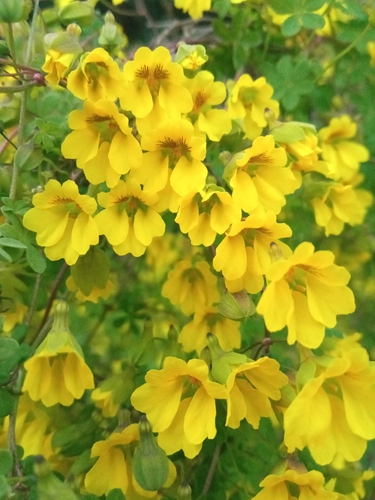
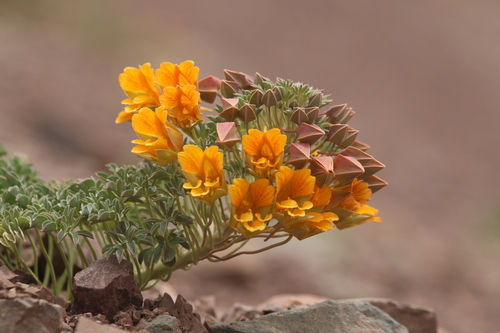
This plant is a herbaceous perennial, Tropaeolum polyphyllum Cav., that overwinters as a deep underground tuber. It produces long rhizomes that develop into trailing shoots that spread across the ground. These trailing shoots are densely covered in silvery green, deeply lobed leaves. Its flower buds have inflated pale green calyces, with sepals extending backward into a short spur. The relatively large, showy golden yellow flowers grow on long, slender stalks. After mid-summer flowering, the shoots die back and the plant stays dormant until the next year. Tropaeolum polyphyllum is endemic to the central Andes of Chile and Argentina, growing at elevations up to 3,000 metres (9,800 ft) above sea level. Its typical habitat is sparsely vegetated stony ground or scree, where it forms small hummocks of grey-green foliage dotted with yellow flowers. In this region, summer droughts can last several months, and most precipitation falls in winter. The plant’s small, rounded tubers are buried deep in soil, allowing it to survive being covered by snow for multiple months and tolerate temperatures as low as −20 °C (−4 °F). For cultivation, Tropaeolum polyphyllum requires full sun and neutral or slightly acidic, well-drained soil. It grows well on hot, dry banks, and is hardy once fully established. It can be propagated from tubers or seed. Seeds should be sown in spring in well-drained compost, and covered with 1 to 2 cm (0.4 to 0.8 in) of sand. Containers should be kept at temperatures below 4 °C (39 °F) until seedlings emerge after about one month. High temperatures prevent germination. This plant is rated for USDA Hardiness Zone 7.