About Troilus luridus (Fabricius, 1775)
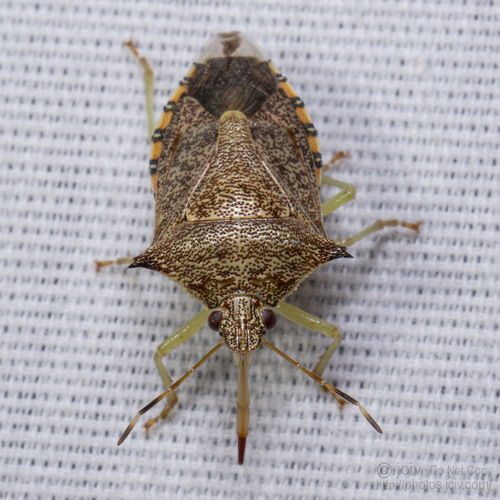
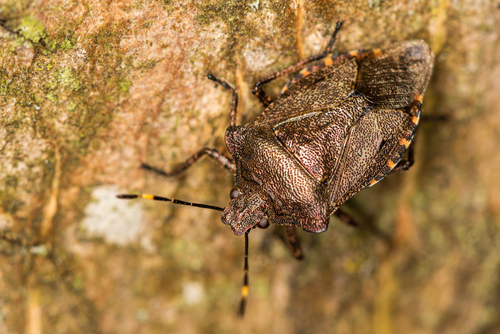
Troilus luridus is a large predatory bronze-brown shieldbug belonging to the family Pentatomidae. It reaches a length of approximately 10 to 12 millimeters, with a distinctive orange band on the penultimate antennal segment. Its legs are brown, and the scutellum does not have an orange tip. Live prey is required for this species to develop. Adult bugs move slowly to search for prey, which is most commonly larvae, but may also include adult beetles, butterflies, and moths. They hold prey at the tip of the rostrum using mandibular and maxillary stylets, which spread out inside the prey to cut away tissue. This species overwinters in the adult life stage, and emerges in April depending on local temperatures. Eggs are laid in batches during May and June. The first batch typically contains around 21 eggs, and batch size decreases with subsequent layings, until eggs are finally laid singly or in pairs. At temperatures between 19 and 20 °C, eggs develop in 10 to 12 days. First instar nymphs are phytophagous and gregarious, and the species goes through a total of five nymphal instars. Newly matured adults can be found starting in July, with timing dependent on temperature, humidity, and prey availability. This bronze shieldbug occurs across most of Europe, and is one of four carnivorous shieldbug species present in Great Britain. While it is never observed in large numbers, it is likely very common overall. It lives in trees, so individuals spotted on lower branches make up only a small fraction of the total population.